Report an issue
Tell us what's wrong and we'll take a look.
Thanks – we got it. We'll review and follow up if needed.
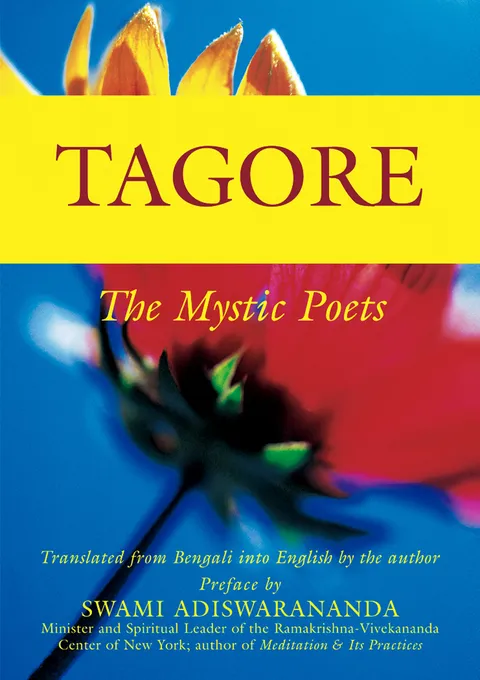
Discover How Tagore’s Spiritual Life and Vision Can Enlighten Your Own
"Rabindranath Tagore’s philosophical and spiritual thoughts transcend all limits of language, culture, and nationality. In his writings, the poet and mystic takes us on a spiritual quest and gives us a glimpse of the infinite in the midst of the finite, unity at the heart of all diversity, and the Divine in all beings and things of the universe."
—from the Preface bySwami Adiswarananda
Rabindranath Tagore is one of the most influential mystic poets and teachers of the last century. Deeply spiritual and profoundly sensitive, his verse speaks to people from all backgrounds who seek a deeper understanding of self, country, creation, God, and love.
This beautiful sampling of Tagore’s two most important works, The Gardener and Gitanjali, offers a glimpse into his spiritual vision that has inspired people around the world. Poems from The Gardener explore youth and earthly love, while excerpts from Gitanjali express divine love and Tagore’s difficulty in satisfying it.
Overwhelmingly mystical and lovely in its simplicity, this unique collection offers insight into Tagore’s heavenly desires, his ongoing quest for Brahama Vihara, the joy eternal, and illuminates the remarkable diversity that made him the most important bridge between the spirituality of the East and West in the first half of the twentieth century.
Rabindranath Tagore
Rabindranath Tagore (1861-1941) was the youngest son of Debendranath Tagore, a leader of the Brahmo Samaj. He was educated at home and although at seventeen he was sent to England for formal schooling, he did not finish his studies there. In his mature years, in addition to his many-sided literary activities, he managed the family estates, a project which brought him into close touch with common humanity and increased his interest in social reforms. He also started an experimental school at Shantiniketan where he tried his Upanishadic ideals of education. From time to time he participated in the Indian nationalist movement, though in his own non-sentimental and visionary way; and Gandhi, the political father of modern India, was his devoted friend. Tagore was knighted by the ruling British Government in 1915, but within a few years he resigned the honour as a protest against British policies in India. Tagore had early success as a writer in his native Bengal. With his translations of some of his poems he became rapidly known in the West. In fact, his fame attained a luminous height, taking him across continents on lecture tours and tours of friendship. For the world he became the voice of India's spiritual heritage; and for India, especially for Bengal, he became a great living institution. Although, Tagore wrote successfully in all literary genres, he was first of all a poet. Among his fifty and odd volumes of poetry are Manasi (1890), Sonar Tari (1894), Gitanjali (1910), Gitimalya (1914), and Balaka (1916) . The English renderings of his poetry, which include The Gardener (1913), Fruit-Gathering (1916), and The Fugitive (1921), do not generally correspond to particular volumes in the original Bengali; and in spite of its title, Gitanjali: Song Offerings (1912), the most acclaimed of them, contains poems from other works besides its namesake. Tagore's major plays are Raja (1910), Dakghar (1912), Achalayatan (1912), Muktadhara (1922), and Raktakaravi (1926) . He is the author of several volumes of short stories and a number of novels, among them Gora (1910), Ghare-Baire (1916), and Yogayog (1929).
More by Rabindranath Tagore


Why Readwise Books?
Readwise Books is an ebook & audiobook platform that automatically logs how much you and your friends read, making it fun and easy to read more. Learn more →