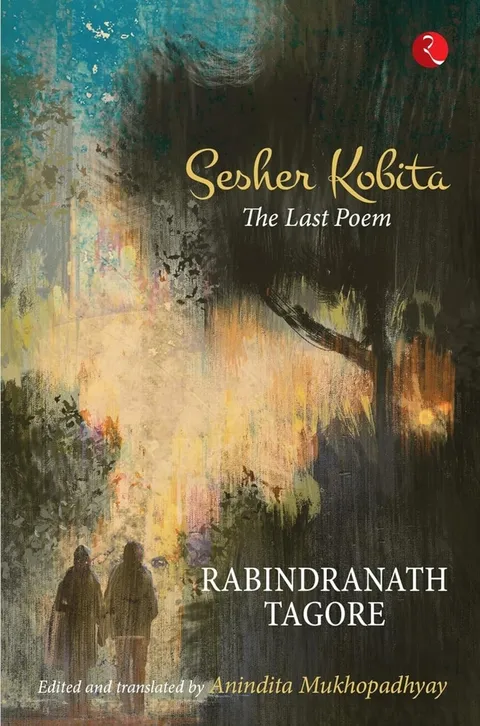
Sesher Kobita the Last Poem
Report an issue
Tell us what's wrong and we'll take a look.
Thanks – we got it. We'll review and follow up if needed.
In Sesher Kbaita, Rabindranath Tagore knocks away social and familial props just to set a young man and a woman talking to one another. Tagore maps the emotional evolution through a series of scintillating conversations between the two protagonists, Amit Rai andabanyalata. Seshar Kabita has manyayers, it is an unusualove story on the surface, but the deeper one moves into the story, one realizes that Tagore is subtly slipping in other elements as well. Isove important in marriage? Does marriageeave space, physical and mental, for both the partners? And then there is Tagore's awareness of the Bengalianguage itself, with which he plays elaborateanguage games. The startlingly contemporaneous engagement with issues of romanticove and the responsibilities and everydayness of marriage is gripping there may be nods of agreement or skeptical headshakes, but to avoid reflection on the questions Tagore raises is impossible.
Rabindranath Tagore
Rabindranath Tagore (1861–1941) was a Nobel Laureate in literature. (1913). He wrote successfully in all literary genres, but was, first and foremost, a poet, publishing more than fifty volumes of poetry. He wrote novels, plays, musical dramas, dance dramas, essays, travel
diaries and two autobiographies. He also left numerous drawings and paintings, and songs for which he wrote the music himself. He was the composer of the national anthem of independent India and Bangladesh. He was born in Calcutta, travelled around the world, and was knighted
in 1915. He gave up his knighthood after the Jallianwala Bagh massacre in 1919.
Among his many works are Manasi (1890), Sonar Tari (1894), Gitanjali (1910), Gitimalya (1914), Balaka (1916), The Gardener (1913), Fruit-Gathering (1916), The Fugitive (1921), Raja (1910), Dakghar (1912), Achalayatan (1912), Muktadhara (1922), Raktakaravi (1926), Gora (1910), Ghare-Baire (1916) and Yogayog (1929).
More by Rabindranath Tagore


Why Readwise Books?
Readwise Books is an ebook & audiobook platform that automatically logs how much you and your friends read, making it fun and easy to read more. Learn more →