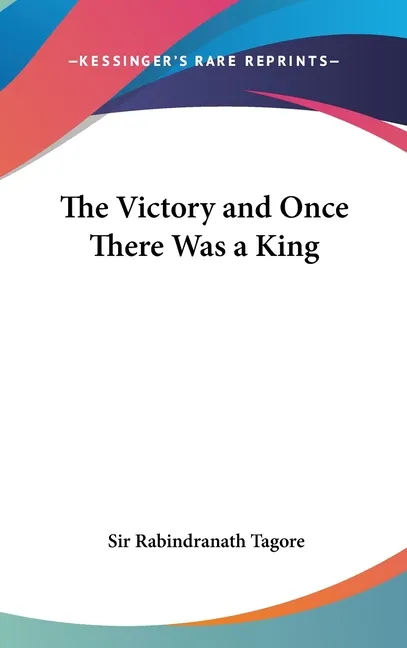
The Victory and Once There Was a King
Report an issue
Tell us what's wrong and we'll take a look.
Thanks – we got it. We'll review and follow up if needed.
The Victory and Once There Was a King are two plays by Sir Rabindranath Tagore, a Bengali polymath and Nobel laureate. The plays are presented in this book as a dual edition, providing readers with the opportunity to explore Tagore's theatrical works in one volume. The Victory is a play that explores the themes of love, war, and sacrifice. The story follows the journey of a young prince who must choose between his love for a woman and his duty to his kingdom. The play is set against the backdrop of a war between two neighboring kingdoms, and the prince's decision ultimately leads to a surprising victory for his people.Once There Was a King is a play that explores the themes of power, corruption, and redemption. The story follows the journey of a king who becomes corrupt and oppressive, leading to unrest and rebellion in his kingdom. The king is eventually overthrown and exiled, but he is given a chance at redemption when he meets a wise hermit who helps him see the error of his ways.Both plays are written in Tagore's signature poetic style, with rich language and vivid imagery. They offer a glimpse into the complex social and political issues of Tagore's time, as well as universal themes that continue to resonate with readers today. This book is a must-read for anyone interested in Indian literature, theater, or philosophy.THIS 36 PAGE ARTICLE WAS EXTRACTED FROM THE BOOK: The Hungry Stones and Other Stories, by Sir Rabindranath Tagore. To purchase the entire book, please order ISBN 0766182878.This scarce antiquarian book is a facsimile reprint of the old original and may contain some imperfections such as library marks and notations. Because we believe this work is culturally important, we have made it available as part of our commitment for protecting, preserving, and promoting the world's literature in affordable, high quality, modern editions, that are true to their original work.
Rabindranath Tagore
Rabindranath Tagore (1861-1941) was the youngest son of Debendranath Tagore, a leader of the Brahmo Samaj. He was educated at home and although at seventeen he was sent to England for formal schooling, he did not finish his studies there. In his mature years, in addition to his many-sided literary activities, he managed the family estates, a project which brought him into close touch with common humanity and increased his interest in social reforms. He also started an experimental school at Shantiniketan where he tried his Upanishadic ideals of education. From time to time he participated in the Indian nationalist movement, though in his own non-sentimental and visionary way; and Gandhi, the political father of modern India, was his devoted friend. Tagore was knighted by the ruling British Government in 1915, but within a few years he resigned the honour as a protest against British policies in India. Tagore had early success as a writer in his native Bengal. With his translations of some of his poems he became rapidly known in the West. In fact, his fame attained a luminous height, taking him across continents on lecture tours and tours of friendship. For the world he became the voice of India's spiritual heritage; and for India, especially for Bengal, he became a great living institution. Although, Tagore wrote successfully in all literary genres, he was first of all a poet. Among his fifty and odd volumes of poetry are Manasi (1890), Sonar Tari (1894), Gitanjali (1910), Gitimalya (1914), and Balaka (1916) . The English renderings of his poetry, which include The Gardener (1913), Fruit-Gathering (1916), and The Fugitive (1921), do not generally correspond to particular volumes in the original Bengali; and in spite of its title, Gitanjali: Song Offerings (1912), the most acclaimed of them, contains poems from other works besides its namesake. Tagore's major plays are Raja (1910), Dakghar (1912), Achalayatan (1912), Muktadhara (1922), and Raktakaravi (1926) . He is the author of several volumes of short stories and a number of novels, among them Gora (1910), Ghare-Baire (1916), and Yogayog (1929).
More by Rabindranath Tagore


Why Readwise Books?
Readwise Books is an ebook & audiobook platform that automatically logs how much you and your friends read, making it fun and easy to read more. Learn more →