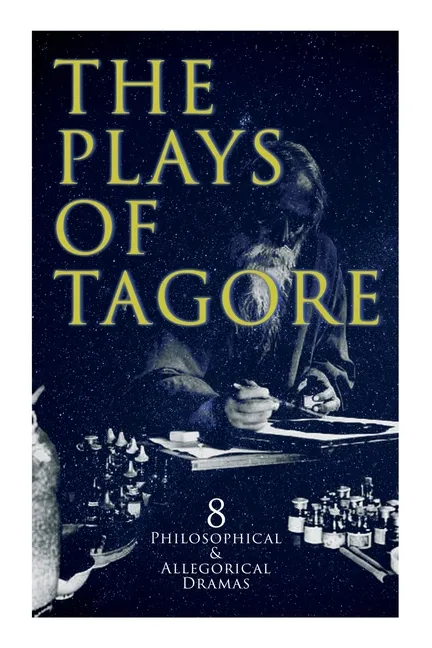
The Plays of Tagore: 8 Philosophical & Allegorical Dramas
The Post Office, Chitra, the Cycle of Spring, the King of the Dark Chamber, Sanyasi...
Report an issue
Tell us what's wrong and we'll take a look.
Thanks – we got it. We'll review and follow up if needed.
In "The Plays of Tagore: 8 Philosophical & Allegorical Dramas," Rabindranath Tagore presents a profound exploration of human existence, interweaving intricate themes of love, spirituality, and societal norms. Written in the early 20th century, these plays reflect a synthesis of Western and Eastern literary traditions, characterized by Tagore's lyrical prose and symbolic motifs. The dramas encapsulate both personal and collective struggles, invoking philosophical inquiries that resonate with universal truths, thus offering rich material for readers and scholars alike to dissect the layers of meaning embedded within each performance. Rabindranath Tagore, the first non-European Nobel laureate in Literature, was a polymath whose experiences as a Bengali poet, musician, and philosopher deeply influenced his literary landscape. His cultural background, along with his interactions with the socio-political upheavals of colonial India, equipped him with a unique perspective on human dilemmas. His commitment to fostering a dialogue between East and West remained a pivotal inspiration behind his dramatic works, elevating them to a discourse on human aspirations and metaphysical musings. "The Plays of Tagore" is an essential read for anyone interested in the intersections of philosophy, drama, and cultural identity. It offers a rich tapestry of human emotions and ethical contemplations that challenge the reader to reflect on their own purpose and place in the universe, making it indispensable for both academic and casual readers.
Rabindranath Tagore
Rabindranath Tagore (1861-1941) was the youngest son of Debendranath Tagore, a leader of the Brahmo Samaj. He was educated at home and although at seventeen he was sent to England for formal schooling, he did not finish his studies there. In his mature years, in addition to his many-sided literary activities, he managed the family estates, a project which brought him into close touch with common humanity and increased his interest in social reforms. He also started an experimental school at Shantiniketan where he tried his Upanishadic ideals of education. From time to time he participated in the Indian nationalist movement, though in his own non-sentimental and visionary way; and Gandhi, the political father of modern India, was his devoted friend. Tagore was knighted by the ruling British Government in 1915, but within a few years he resigned the honour as a protest against British policies in India. Tagore had early success as a writer in his native Bengal. With his translations of some of his poems he became rapidly known in the West. In fact, his fame attained a luminous height, taking him across continents on lecture tours and tours of friendship. For the world he became the voice of India's spiritual heritage; and for India, especially for Bengal, he became a great living institution. Although, Tagore wrote successfully in all literary genres, he was first of all a poet. Among his fifty and odd volumes of poetry are Manasi (1890), Sonar Tari (1894), Gitanjali (1910), Gitimalya (1914), and Balaka (1916) . The English renderings of his poetry, which include The Gardener (1913), Fruit-Gathering (1916), and The Fugitive (1921), do not generally correspond to particular volumes in the original Bengali; and in spite of its title, Gitanjali: Song Offerings (1912), the most acclaimed of them, contains poems from other works besides its namesake. Tagore's major plays are Raja (1910), Dakghar (1912), Achalayatan (1912), Muktadhara (1922), and Raktakaravi (1926) . He is the author of several volumes of short stories and a number of novels, among them Gora (1910), Ghare-Baire (1916), and Yogayog (1929).
More by Rabindranath Tagore


Why Readwise Books?
Readwise Books is an ebook & audiobook platform that automatically logs how much you and your friends read, making it fun and easy to read more. Learn more →