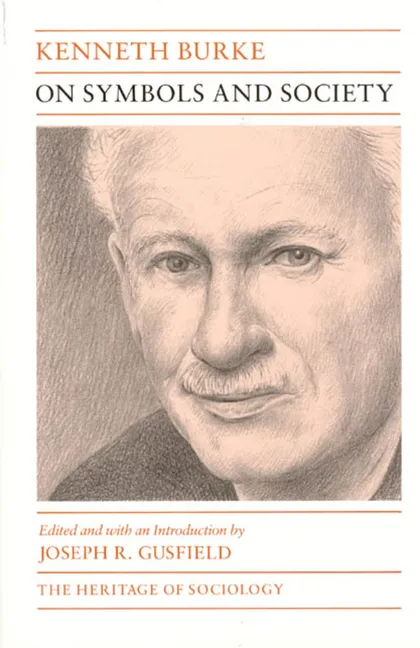
On Symbols and Society
Report an issue
Tell us what's wrong and we'll take a look.
Thanks – we got it. We'll review and follow up if needed.
In his superb introductory essay, Joseph R. Gusfield traces the development of Burke's approach to human action and its relationship to other similar sources of theory and ideas in sociology; he discusses both Burke's influence on sociologists and the limits of his perspective. Burke regards literature as a form of human behavior--and human behavior as embedded in language. His lifework represents a profound attempt to understand the implications for human behavior based on the fact that humans are "symbol-using animals." As this volume demonstrates, the work that Burke produced from the 1930s through the 1960s stands as both precursor and contemporary key to recent intellectual movements such as structuralism, symbolic anthropology, phenomenological and interpretive sociology, critical theory, and the renaissance of symbolic interaction.
Kenneth Burke
Kenneth Burke was a self-taught thinker who attempted to integrate scientific and philosophical concepts with his analysis of semantics and literature. Between 1927 and 1929, Burke worked for the "Dial "as a music critic. After a brief stint with "The Nation "(1934-36), he turned to literary criticism and taught at Bennington College from 1943 to 1961. His many works have all been published by the University of California Press.
More by Kenneth Burke









Why Readwise Books?
Readwise Books is an ebook & audiobook platform that automatically logs how much you and your friends read, making it fun and easy to read more. Learn more →