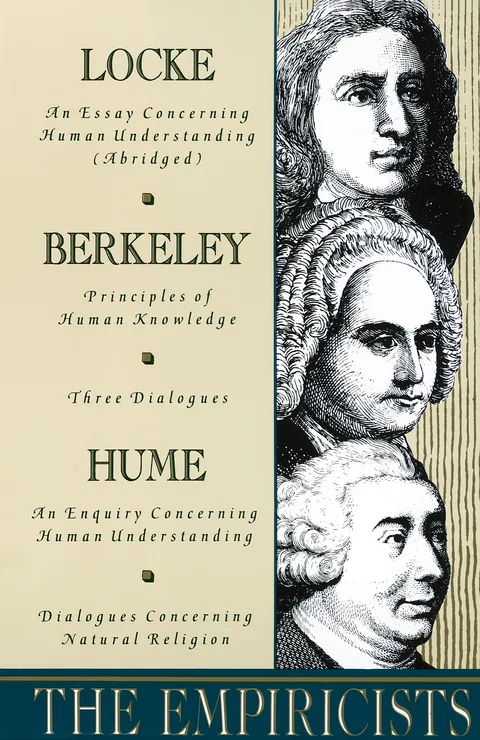
The Empiricists
Locke: Concerning Human Understanding; Berkeley: Principles of Human Knowledge & 3 Dialogues; Hume: Concerning Human Understanding & Concerning Natural Religion
Report an issue
Tell us what's wrong and we'll take a look.
Thanks – we got it. We'll review and follow up if needed.
The rise and fall of British Empiricism is philosophy's most dramatic example of pushing premises to their logical--and fatal--conclusions. Born in 1690 with the appearance of Locke's Essay, Empiricism flourished as the reigning school until 1739 when Hume's Treatise strangled it with its own cinctures after a period of Berkeley's optimistic idealism. The Empiricists collects the key writings on this important philosophy, perfect for those interested in learning about this movement with just one book.












David Hume
David Hume was an eighteenth-century Scottish philosopher, historian, and essayist, and the author of A Treatise of Human Nature, considered by many to be one of the most important philosophical works ever published.
Hume attended the University of Edinburgh at an early age and considered a career in law before deciding that the pursuit of knowledge was his true calling. Hume’s writings on rationalism and empiricism, free will, determinism, and the existence of God would be enormously influential on contemporaries such as Adam Smith, as well as the philosophers like Schopenhauer, John Stuart Mill, and Karl Popper, who succeeded him. Hume died in 1776.
More by David Hume













Why Readwise Books?
Readwise Books is an ebook & audiobook platform that automatically logs how much you and your friends read, making it fun and easy to read more. Learn more →