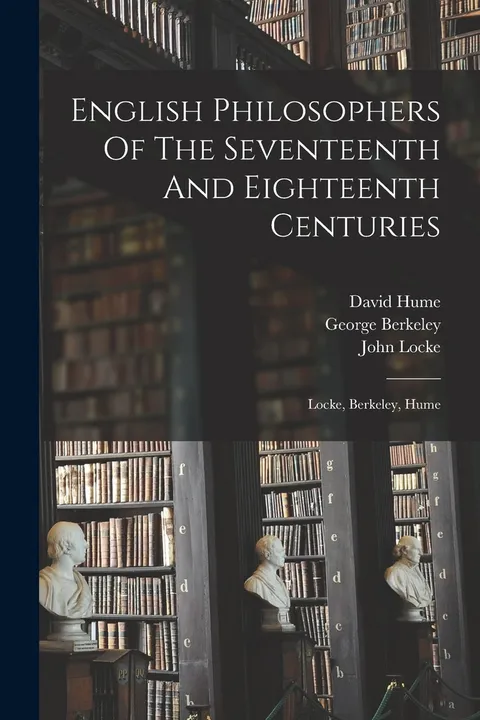
English Philosophers Of The Seventeenth And Eighteenth Centuries
Locke, Berkeley, Hume
Report an issue
Tell us what's wrong and we'll take a look.
Thanks – we got it. We'll review and follow up if needed.
This work has been selected by scholars as being culturally important, and is part of the knowledge base of civilization as we know it.
This work is in the "public domain in the United States of America, and possibly other nations. Within the United States, you may freely copy and distribute this work, as no entity (individual or corporate) has a copyright on the body of the work.
Scholars believe, and we concur, that this work is important enough to be preserved, reproduced, and made generally available to the public. We appreciate your support of the preservation process, and thank you for being an important part of keeping this knowledge alive and relevant.
John Locke
JOHN LOCKE has been fascinated by the pulp magazine era and its fiction, particularly in the 1920s and 1930s, for many decades. In the 1990s he started collecting information on the era, which led to writing historical treatments about the publishers, editors, and most of all the authors. Many of his findings have been published in his Off-Trail Publications books. Charles Beadle featured in two collections of Africa adventure fiction (The City of Baal, 2007; The Land of Ophir, 2012). In 2018, Locke jumped up to book-length histories with The Thing's Incredible! The Secret Origins of Weird Tales. He's currently completing a book about writers behaving badly in the 1920s.
More by John Locke












David Hume
David Hume was an eighteenth-century Scottish philosopher, historian, and essayist, and the author of A Treatise of Human Nature, considered by many to be one of the most important philosophical works ever published.
Hume attended the University of Edinburgh at an early age and considered a career in law before deciding that the pursuit of knowledge was his true calling. Hume’s writings on rationalism and empiricism, free will, determinism, and the existence of God would be enormously influential on contemporaries such as Adam Smith, as well as the philosophers like Schopenhauer, John Stuart Mill, and Karl Popper, who succeeded him. Hume died in 1776.
More by David Hume




Why Readwise Books?
Readwise Books is an ebook & audiobook platform that automatically logs how much you and your friends read, making it fun and easy to read more. Learn more →