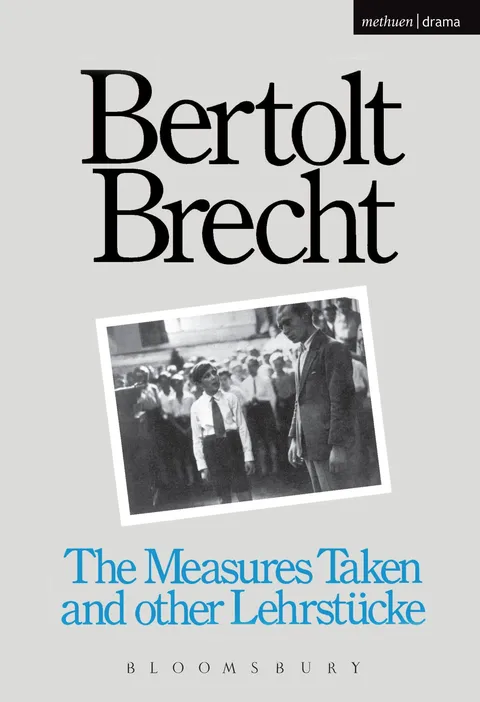
Measures Taken and Other Lehrstucke
Report an issue
Tell us what's wrong and we'll take a look.
Thanks – we got it. We'll review and follow up if needed.
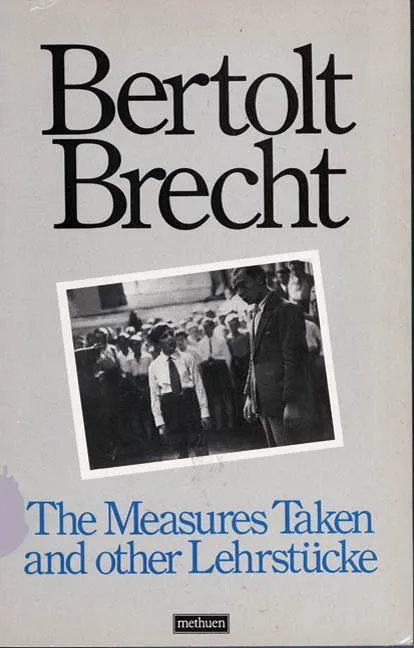
Written during 1929 and 1930, years of far-reaching political and economic upheaveal in Germany and the period of Brecht's most sharply Communist works, these short plays show an abrupt rejection of most of the trappings of conventional theatre.
The Lehrstücke are spare and highly formalized pieces intended for performance by amateurs, on the principle that the moral and political lessons contained in them can best be taught by participation in an actual production. There is nothing in the drama of the twentieth century to match the precision of their language and the economy of their theatrical technique.
Bertolt Brecht
Bertolt Brecht (1898-1956) was a German poet, playwright, and theater director. An influential theater practitioner of the 20th century, Brecht made equally significant contributions to dramaturgy and theatrical production, the latter particularly through the seismic impact of the tours undertaken by the Berliner Ensemble-the post-war theater company operated by Brecht and his wife and long-time collaborator, the actress Helene Weigel-with its internationally acclaimed productions.
More by Bertolt Brecht




Carl R Mueller
Translated by
Carl R. Mueller was Professor Emeritus at the UCLA School of Theater, Film and Television, and a noted translator of classic plays in several languages. He was a professor in the critical studies program of the UCLA theater department, teaching theatre history and literature, dramatic criticism and playwriting. He was an internationally acclaimed translator, especially of the works in the modern German theatrical repertoire. He died in 2008 at the age of 76.


Why Readwise Books?
Readwise Books is an ebook & audiobook platform that automatically logs how much you and your friends read, making it fun and easy to read more. Learn more →