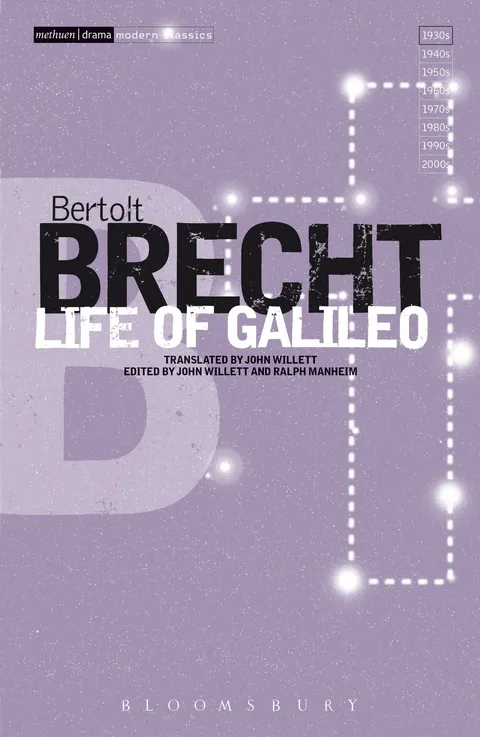
Life Of Galileo
Report an issue
Tell us what's wrong and we'll take a look.
Thanks – we got it. We'll review and follow up if needed.

Along with Mother Courage, the character of Galileo is one of Brecht's greatest creations, immensely live, human and complex. Unable to resist his appetite for scientific investigation, Galileo's heretical discoveries about the solar system bring him to the attention of the Inquisition. He is scared into publicly abjuring his theories but, despite his self-contempt, goes on working in private, eventually helping to smuggle his writings out of the country.
As an examination of the problems that face not only the scientist but also the whole spirit of free inquiry when brought into conflict with the requirements of government or official ideology, Life of Galileo has few equals.
Written in exile in 1937-9 and first performed in Zurich in 1943, Galileo was first staged in English in 1947 by Joseph Losey in a version jointly prepared by Brecht and Charles Laughton, who played the title role. Printed here is the complete translation by Brecht scholar John Willett. The much shorter Laughton version is also included in full as an appendix, along with Brecht's own copious notes on the play making this the most trusted scholarly edition of the text.
Bertolt Brecht
Bertolt Brecht (1898-1956) was a German poet, playwright, and theater director. An influential theater practitioner of the 20th century, Brecht made equally significant contributions to dramaturgy and theatrical production, the latter particularly through the seismic impact of the tours undertaken by the Berliner Ensemble-the post-war theater company operated by Brecht and his wife and long-time collaborator, the actress Helene Weigel-with its internationally acclaimed productions.
More by Bertolt Brecht










Why Readwise Books?
Readwise Books is an ebook & audiobook platform that automatically logs how much you and your friends read, making it fun and easy to read more. Learn more →