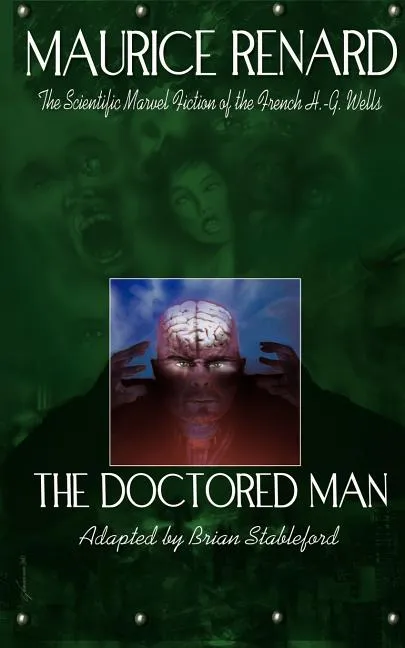
The Doctored Man
Report an issue
Tell us what's wrong and we'll take a look.
Thanks – we got it. We'll review and follow up if needed.
Often hailed as the best French science fiction writer of the early 20th century, Maurice Renard coined the term "Scientific Marvel Fiction" to pen a series of gripping, ground-breaking stories that owe as much to Edgar Allan Poe as they do to H.-G. Wells. Until now, Renard was best known to the English-speaking public for his thrice-filmed thriller, The Hands of Orlac. The Doctored Man, a collection of 14 stories written between 1913 and 1939, features a man blinded during WWI who, through the grafting of "electroscopic" eyes, can see into other dimensions, the classic The Man Who Wanted To Be Invisible in which Renard exposes the scientific fallacy inherent in Wells' famous novel, as well as other ground-breaking tales of time-travel, prehistoric wing-men, intangibility, robotic cars and interplanetary travel! This is the fourth in a series of five volumes, translated and annotated by Brian Stableford, devoted to presenting the classic works of this pioneering giant of French science fiction.
Maurice Renard
Maurice Renard was born on February 28, 1875, in Ch lons-en-Champagne to parents whose names are not widely recorded in available biographical sources. Renard developed a reputation as a pioneering French writer of speculative and science-based fiction. His literary career gained momentum with the publication of Le Docteur Lerne, sous-dieu in 1908, a novel influenced by H.G. Wells that explored themes of transplant surgery, including grafts between humans, animals, and even machines. Renard s fascination with the philosophical boundaries of science continued in Le P ril Bleu (1910), which imagined invisible extraterrestrials studying humans like specimens. He went on to write Les Mains d'Orlac (1920), in which a pianist receives the hands of a murderer, blending horror with psychological tension. His works such as L'Homme Truqu and Le Singe explored artificial senses and synthetic life. Renard also tackled miniaturization in Un Homme chez les Microbes: Scherzo and toyed with temporal physics in Le Ma tre de la Lumi re. He often challenged popular scientific concepts with creative twists, offering early critiques of invisibility and cloning. His novels reflect a blend of imagination and inquiry into the ethics and consequences of science. He died in Rochefort-sur-Mer on November 18, 1939.
More by Maurice Renard






Why Readwise Books?
Readwise Books is an ebook & audiobook platform that automatically logs how much you and your friends read, making it fun and easy to read more. Learn more →