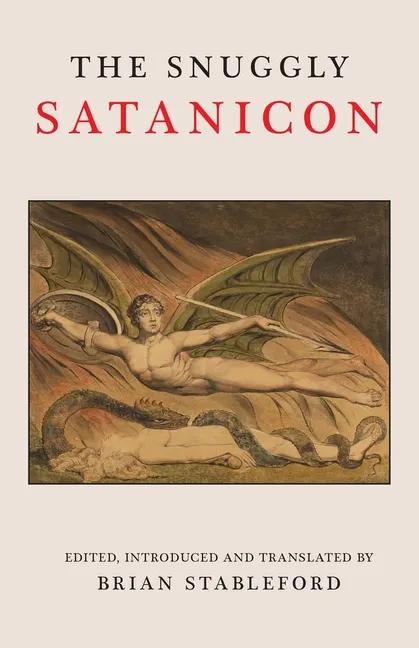
The Snuggly Satanicon
Report an issue
Tell us what's wrong and we'll take a look.
Thanks – we got it. We'll review and follow up if needed.
The current volume, edited and translated from the French by Brian Stableford, brings together fourteen stories composed in the thriving tradition of "literary Satanism" that was pioneered in the 1820s and continued throughout the century and into the twentieth, which subjected the figure to closer and more skeptical scrutiny than the theologians of the past, attempting a more clinical analysis of the idea.
Including such fiendish pieces as "A Dream of Hell" by Gustave Flaubert, which was written when the author was sixteen years old, and "Dead Man's Dale," a classic tale of the Devil by the great Romantic writer Charles Nodier, The Snuggly Satanicon provides a useful additional piece of a much vaster jigsaw comprised by one of the chief imaginary motifs of modern literature, helping to provide a broader glimpse, and hence a more accurate appreciation, of a bigger picture.








Maurice Renard
Maurice Renard was born on February 28, 1875, in Ch lons-en-Champagne to parents whose names are not widely recorded in available biographical sources. Renard developed a reputation as a pioneering French writer of speculative and science-based fiction. His literary career gained momentum with the publication of Le Docteur Lerne, sous-dieu in 1908, a novel influenced by H.G. Wells that explored themes of transplant surgery, including grafts between humans, animals, and even machines. Renard s fascination with the philosophical boundaries of science continued in Le P ril Bleu (1910), which imagined invisible extraterrestrials studying humans like specimens. He went on to write Les Mains d'Orlac (1920), in which a pianist receives the hands of a murderer, blending horror with psychological tension. His works such as L'Homme Truqu and Le Singe explored artificial senses and synthetic life. Renard also tackled miniaturization in Un Homme chez les Microbes: Scherzo and toyed with temporal physics in Le Ma tre de la Lumi re. He often challenged popular scientific concepts with creative twists, offering early critiques of invisibility and cloning. His novels reflect a blend of imagination and inquiry into the ethics and consequences of science. He died in Rochefort-sur-Mer on November 18, 1939.
More by Maurice Renard







Why Readwise Books?
Readwise Books is an ebook & audiobook platform that automatically logs how much you and your friends read, making it fun and easy to read more. Learn more →