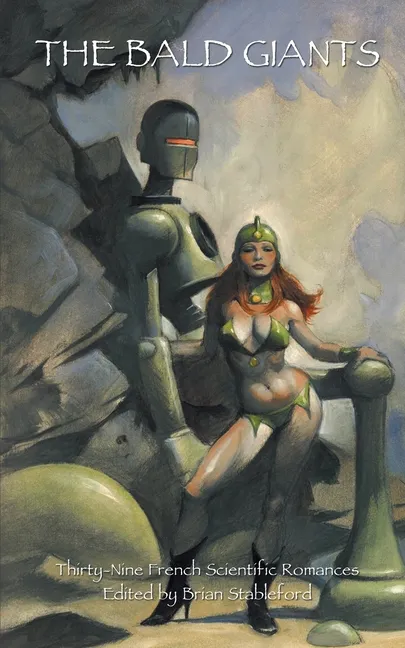
The Bald Giants
Report an issue
Tell us what's wrong and we'll take a look.
Thanks – we got it. We'll review and follow up if needed.
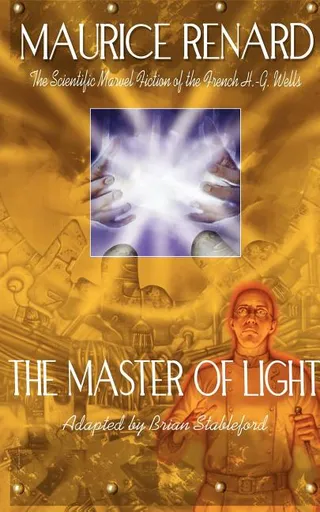
This anthology collects stories belonging, at least approximately, to the genre of scientific fiction, which were published in various periodicals between 1886 and 1938. Many of them were never reprinted in book form.
The early stories--which are arranged in the chronological order of their publication--were produced in an era of relative optimism with regard to scientific advancement, when the rewards of scientific research were widely seen as a cornucopia; but even where that notion is explicit within the stories, it is generally fitted with a compulsory irony.
Attitudes changed because of the legacy of the Great War, which considerably eroded confidence in the future and provided a graphic illustration of the fact that technological advancement favored the power to destroy as well as the ability to construct.
Some of the notions deployed in those experimental ventures subsequently became clichés, but were not at the time of their publication, and deserve credit for their pioneering spirit, as well as their fast pace and easy readability.
Maurice Renard
Maurice Renard was born on February 28, 1875, in Ch lons-en-Champagne to parents whose names are not widely recorded in available biographical sources. Renard developed a reputation as a pioneering French writer of speculative and science-based fiction. His literary career gained momentum with the publication of Le Docteur Lerne, sous-dieu in 1908, a novel influenced by H.G. Wells that explored themes of transplant surgery, including grafts between humans, animals, and even machines. Renard s fascination with the philosophical boundaries of science continued in Le P ril Bleu (1910), which imagined invisible extraterrestrials studying humans like specimens. He went on to write Les Mains d'Orlac (1920), in which a pianist receives the hands of a murderer, blending horror with psychological tension. His works such as L'Homme Truqu and Le Singe explored artificial senses and synthetic life. Renard also tackled miniaturization in Un Homme chez les Microbes: Scherzo and toyed with temporal physics in Le Ma tre de la Lumi re. He often challenged popular scientific concepts with creative twists, offering early critiques of invisibility and cloning. His novels reflect a blend of imagination and inquiry into the ethics and consequences of science. He died in Rochefort-sur-Mer on November 18, 1939.
More by Maurice Renard





Why Readwise Books?
Readwise Books is an ebook & audiobook platform that automatically logs how much you and your friends read, making it fun and easy to read more. Learn more →