Report an issue
Tell us what's wrong and we'll take a look.
Thanks – we got it. We'll review and follow up if needed.
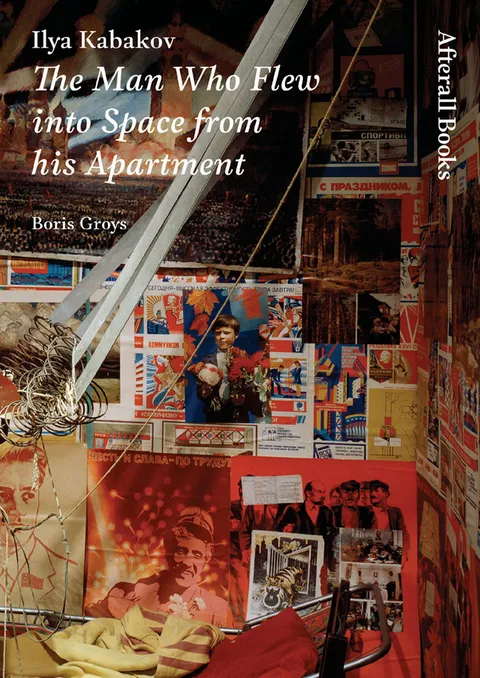
The fictitious hero of this 1984 installation is a lonely dreamer who develops an impossible project: to fly alone in cosmic space. But this dream is also an individual appropriation of a collective Soviet project and the official Soviet propaganda connected to it. Having built a makeshift slingshot, the hero apparently flies through the ceiling of his shabby room and vanishes into space. The miserable room and the primitive slingshot suggest the reality behind the Soviet utopia, in which where cosmic vision and the political project of the Communist revolution are seen as indissoluble.
The Man who Flew into Space from His Apartment also raises questions of authorship in modernity. All of Kabakov's work is made in the name of other, fictitious artists. This reveals a hidden rule of the modern art system: only an artist who doesn't want to be an artist or who doesn't even know that he is an artist is a real artist--just as only an artwork that does not look like an artwork is a real artwork. The installation is a narrative, the documentation of a fictitious event.
Afterall Books are distributed by The MIT Press.
Boris Groys
Boris Groys is Professor of Aesthetics, Art History and Media Theory at the Center for Art and Media Technology in Karlsruhe and, since 2005, the Global Distinguished Professor in the Faculty of Arts and Science, NYU. He has published numerous books, including On the New, Introduction to Antiphilosophy, The Total Art of Stalinism, and In the Flow.
More by Boris Groys


Why Readwise Books?
Readwise Books is an ebook & audiobook platform that automatically logs how much you and your friends read, making it fun and easy to read more. Learn more →