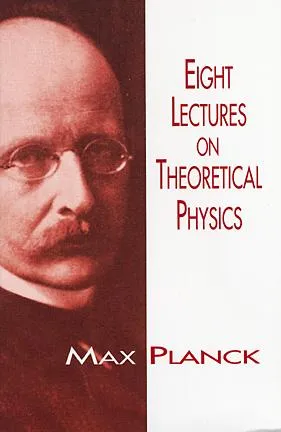
Eight Lectures on Theoretical Physics
Report an issue
Tell us what's wrong and we'll take a look.
Thanks – we got it. We'll review and follow up if needed.
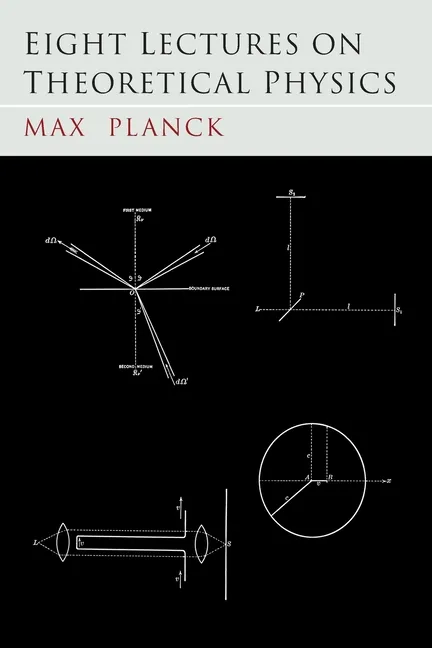
The first, third, fifth, and sixth lectures present his account of the revolutionary developments occasioned when he first applied the quantum hypothesis to blackbody radiation. The reader is given a valuable opportunity to witness Planck's thought processes both on the level of philosophical principles as well as their application to physical processes on the microscopic and macroscopic scales.
In the second and fourth lectures Planck shows how the new ideas of statistical mechanics transformed the understanding of chemical physics. The seventh lecture discusses the principle of least action, while the final one gives an account of the theory of special relativity, of which Planck had been an early champion.
These lectures are especially important since they reflect Planck's reconsiderations and rethinking of his original discovery of quantum theory. A new Introduction by Peter Pesic places this book in historical perspective among Planck's works and those of his contemporaries. Now available in this inexpensive edition, it will be of particular interest to students of modern physics and of the philosophy and history of science.
Max Planck
Max (Karl Ernst Ludwig) Planck was a German physicist and philosopher known for his quantum theory, for which he won the Nobel Prize in Physics in 1918. Planck was born in Kiel, Germany, in 1858 to an academic family, and valued education from a young age. He attended the Universities of Munich and Berlin to study physics under the great scientific leaders Kirchhoff and Helmholtz. His early work focused on the study of thermodynamics, and in 1900 he published a paper on his quantum theory that would change the face of modern physics. Planck worked as a professor at Berlin University his entire career, and served as the president of the Kaiser Wilhelm Society for the Promotion of Science. During World War II, Planck experienced great hardships while he remained in Germany but openly opposed the Nazi regime. One of his two sons was executed during this time for an unsuccessful attempt on Hitler’s life, and Planck’s home in Berlin was eventually bombed. He continued to write about physics and philosophy until his death in 1947.
More by Max Planck




Why Readwise Books?
Readwise Books is an ebook & audiobook platform that automatically logs how much you and your friends read, making it fun and easy to read more. Learn more →