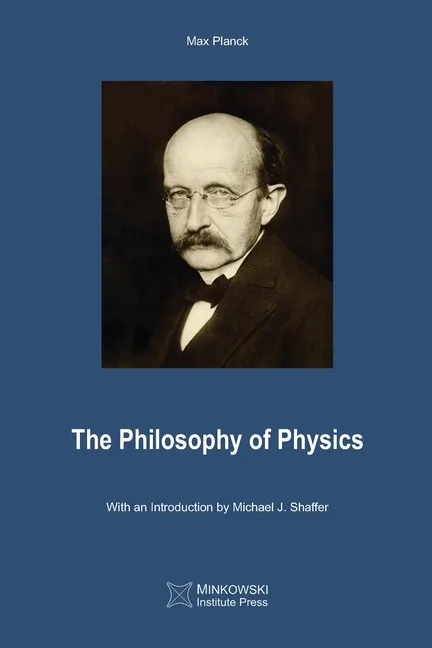
The Philosophy of Physics
Report an issue
Tell us what's wrong and we'll take a look.
Thanks – we got it. We'll review and follow up if needed.
What makes this book by Max Planck - one of the fathers of modern physics (Nobel Prize in Physics 1918) - invaluable is that he presents his entire world view - from the nature of scientific theories (how "the world image," given by a scientific theory, relates to "the world of the senses") to the origin of scientific ideas to the growth of scientific knowledge to the role of causality in science to the interaction between science and philosophy and faith and even to the issue of why "a suitable planning of school teaching is one of the most important conditions of progress in science." A wide range of readers can benefit from reading this book - from experts and students in science and philosophy (who will be exposed to a world view that made Planck one of the greatest physicists of all time) to everyone interested in science and philosophy because the book is written for a wide audience.
Max Planck
Max Karl Ernst Ludwig Planck was a German theoretical physicist whose discovery of energy quanta won him the Nobel Prize in Physics in 1918. Planck made many contributions to theoretical physics, but his fame as a physicist rests primarily on his role as the originator of quantum theory, which revolutionized human understanding of atomic and subatomic processes.
More by Max Planck




Why Readwise Books?
Readwise Books is an ebook & audiobook platform that automatically logs how much you and your friends read, making it fun and easy to read more. Learn more →