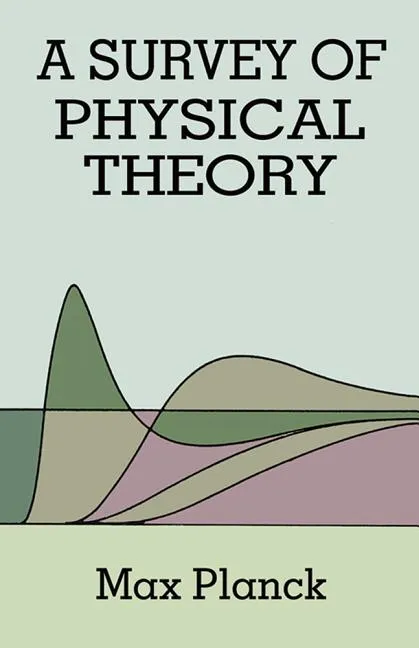
Survey of Physical Theory
Report an issue
Tell us what's wrong and we'll take a look.
Thanks – we got it. We'll review and follow up if needed.
In this classic of scientific literature, the Nobel Laureate and creator of the quantum revolution explores the ideas intrinsic to physics. Planck''s clear, simple presentation is accessible not only to the scientific community but also to other readers. He concludes with an engrossing step-by-step narrative of his development of quantum theory. 1925 edition.
Max Planck
Max (Karl Ernst Ludwig) Planck was a German physicist and philosopher known for his quantum theory, for which he won the Nobel Prize in Physics in 1918. Planck was born in Kiel, Germany, in 1858 to an academic family, and valued education from a young age. He attended the Universities of Munich and Berlin to study physics under the great scientific leaders Kirchhoff and Helmholtz. His early work focused on the study of thermodynamics, and in 1900 he published a paper on his quantum theory that would change the face of modern physics. Planck worked as a professor at Berlin University his entire career, and served as the president of the Kaiser Wilhelm Society for the Promotion of Science. During World War II, Planck experienced great hardships while he remained in Germany but openly opposed the Nazi regime. One of his two sons was executed during this time for an unsuccessful attempt on Hitler’s life, and Planck’s home in Berlin was eventually bombed. He continued to write about physics and philosophy until his death in 1947.
More by Max Planck




Why Readwise Books?
Readwise Books is an ebook & audiobook platform that automatically logs how much you and your friends read, making it fun and easy to read more. Learn more →