Report an issue
Tell us what's wrong and we'll take a look.
Thanks – we got it. We'll review and follow up if needed.
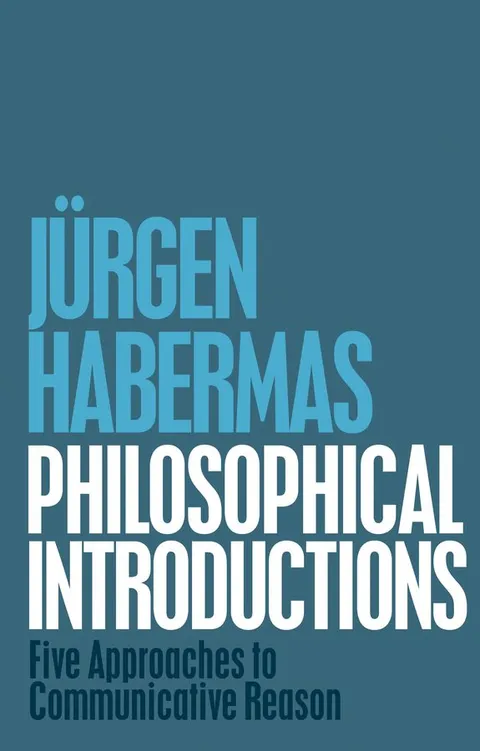
On the occasion of Habermas’s 80th birthday, the German publisher Suhrkamp brought out five volumes of Habermas’s papers that spanned the full range of his philosophical thought, from the theory of rationality to the critique of metaphysics. For each of these volumes, Habermas wrote an introduction that crystallized, in a remarkably clear and succinct way, his thinking on the key philosophical issues that have preoccupied him throughout his long career. This new book by Polity brings together these five introductions and publishes them in translation for the first time. The resulting volume provides a unique and comprehensive overview of Habermas’s philosophy in his own words.
In the five chapters that make up this volume, Habermas discusses the concept of communicative action and the grounding of the social sciences in the theory of language; the relationship between rationality and the theory of language; discourse ethics; political theory and problems of democracy and legitimacy; and the critique of reason and the challenge posed by religion in a secular age. The volume includes a substantial introduction by Jean-Marc Durand-Gasselin, which offers a synoptic view of the development of Habermas’s thought as a whole followed by concise accounts of his contributions in each of the areas mentioned. Together they provide the reader with the necessary background to understand Habermas’s distinctive and original contribution to philosophy.
Philosophical Introductions will be an indispensable text for students and scholars in philosophy and in the humanities and social sciences generally, as well as anyone interested in the most important developments in philosophy and critical theory today.
Jürgen Habermas
J�rgen Habermas was born in 1929, and grew up in Gummersbach, Germany. He was educated at the Universities of Gottingen, Bonn, and Zurich, after which he worked for a while as a freelance journalist. In 1956 he became Adorno's assistant at the University of Frankfurt. From 1961 to 1964 he taught philosophy in Heidelberg, and from 1964 to 1971, philosophy and sociology in Frankfurt. From 1971 to 1983 he was Director of the Max Planck Institute for Research into the Life Conditions of the Scientific-Technical World, in Sternberg. Among his influential publications in English are: Knowledge and Human Interests (1971), Theory and Practice (1973), The Theory of Communicative Action (1984/1987), and Moral Consciousness and Communicative Action (1990).
More by Jürgen Habermas








Why Readwise Books?
Readwise Books is an ebook & audiobook platform that automatically logs how much you and your friends read, making it fun and easy to read more. Learn more →