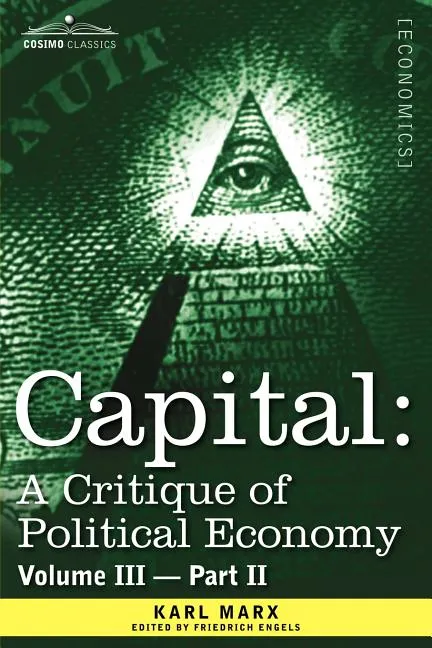
Capital
Report an issue
Tell us what's wrong and we'll take a look.
Thanks – we got it. We'll review and follow up if needed.
First published in 1867, Capital, or Das Kapital, is the infamous treatise on economics and capitalism by Prussian revolutionary KARL MARX (1818-1883), who changed history with his 1848 book The Communist Manifesto. In this work, edited by Marx's friend, German philosopher FRIEDRICH ENGELS (1820-1895), Marx systematically analyzes the way the capitalist machine functions. In this academic work written for students and serious thinkers, he explores wages, competition, banking, rent, and the natural laws that seem to govern the development of capitalism without any oversight by the society in which it developed. Originally published in three volumes, Capital is here presented in five volumes. Volume III, Part 2 covers: . Transformation of Surplus Profit into Ground-Rent . The Revenues and Their Sources
Karl Marx
Karl Marx (1818–1883) was a German philosopher, economist, and political theorist who profoundly influenced the course of history with his revolutionary ideas. Born in Trier, Prussia, Marx, in collaboration with Friedrich Engels, authored The Communist Manifesto and later produced his seminal work, Das Kapital. A visionary thinker, Marx's theories laid the foundation for modern communism and offered a critical analysis of capitalism, highlighting issues of class struggle, economic inequality, and the role of the state. Despite controversy and varied interpretations, Marx's impact on social, political, and economic thought has been enduring, shaping the discourse on societal structures and inspiring movements for social change around the world.
More by Karl Marx





Why Readwise Books?
Readwise Books is an ebook & audiobook platform that automatically logs how much you and your friends read, making it fun and easy to read more. Learn more →