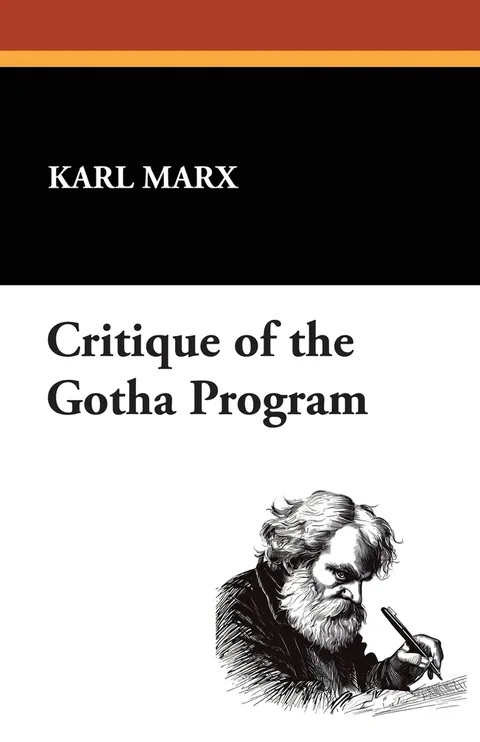
Critique of the Gotha Program
Report an issue
Tell us what's wrong and we'll take a look.
Thanks – we got it. We'll review and follow up if needed.
Offering perhaps Marx's most detailed pronouncement on programmatic matters of revolutionary strategy, The Critique of the Gotha Program discusses the "dictatorship of the proletariat", the period of transition from capitalism to communism, proletarian internationalism and the party of the working class. It is notable also for elucidating the principles of "To each according to his contribution" as the basis for a "lower phase" of communist society directly following the transition from capitalism and "From each according to his ability, to each according to his needs" as the basis for a future "higher phase" of communist society. In describing the lower phase, he states that "the individual receives from society exactly what he gives to it" and advocates remuneration in the form of non-transferable labor vouchers as opposed to money.
The Critique of the Gotha Program, published after his death, was among Marx's last major writings.
Karl Marx
Karl Marx (1818–1883) was a German philosopher, economist, and political theorist who profoundly influenced the course of history with his revolutionary ideas. Born in Trier, Prussia, Marx, in collaboration with Friedrich Engels, authored The Communist Manifesto and later produced his seminal work, Das Kapital. A visionary thinker, Marx's theories laid the foundation for modern communism and offered a critical analysis of capitalism, highlighting issues of class struggle, economic inequality, and the role of the state. Despite controversy and varied interpretations, Marx's impact on social, political, and economic thought has been enduring, shaping the discourse on societal structures and inspiring movements for social change around the world.
More by Karl Marx











Why Readwise Books?
Readwise Books is an ebook & audiobook platform that automatically logs how much you and your friends read, making it fun and easy to read more. Learn more →