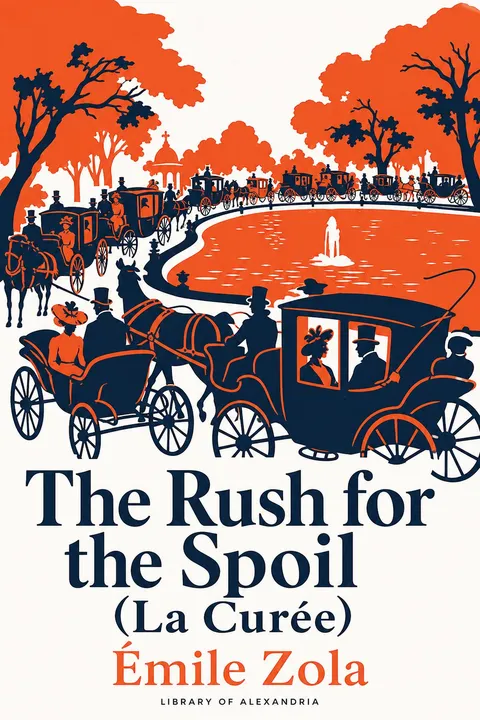
The Rush for the Spoil (La Curée)
Classic French Fiction of Second Empire Paris, Forbidden Desire, and Financial Ambition
Report an issue
Tell us what's wrong and we'll take a look.
Thanks – we got it. We'll review and follow up if needed.
A city is being rebuilt, fortunes are being made, and everything seems available for a price. Behind the glitter of Second Empire Paris, one family turns ambition and desire into instruments of destruction.
In The Rush for the Spoil (La Curée), Émile Zola follows Aristide Saccard, a speculator who sees opportunity in the demolition and reconstruction of Paris. New boulevards mean new fortunes, and Saccard pursues his share with little regard for the people caught in his schemes. His wife, Renée, has wealth and social standing but finds herself neglected within the luxury that surrounds her.
Renée's attraction to her stepson Maxime draws the household into a forbidden relationship that echoes the excesses of the wider city. From the carriages of the Bois de Boulogne to lavish entertainments and speculative deals, Zola brings private longing and public corruption into the same unsettling frame. The second novel in the Rougon-Macquart cycle, this portrait of Paris under Napoleon III endures for its sensory richness and its searching account of what happens when profit becomes a society's guiding principle.
What readers find inside:
- A city transformed - The rebuilding of Paris creates opportunities for speculation while exposing the destructive force of unchecked ambition.
- Renée Saccard - A young woman's loneliness beneath a life of luxury gives the novel its emotional center.
- Forbidden passion - Renée's relationship with Maxime brings desire, boredom, and moral compromise into dangerous alignment.
- Wealth as spectacle - Carriages, balls, and sumptuous interiors reveal a society absorbed in display.
- French naturalism - Zola connects individual choices to the pressures of money, family, and social environment.
For readers of classic French literature, psychologically charged family dramas, and novels about money and power, this is a vivid encounter with the human stakes behind a glittering age.
Enter Zola's Paris and discover what its new fortunes cost the people who pursue them.
Émile Zola
French author, journalist, dramatist, and founder of the naturalism literary movement, Zola also wrote plays. He played a significant role in both Alfred Dreyfus' exoneration and the political liberalisation of France. Dreyfus had been wrongfully charged and imprisoned as an army commander. In 1901 and 1902, Zola was a candidate for the Nobel Prize in Literature. Zola was born in Paris on April 2, 1840, to François Zola and Emilie Aubert. Before becoming a writer, he was a law student who twice failed the baccalaureate. In his formative years, Zola produced a large number of short stories, essays, plays, and novels. Hachette fired Zola from his position as director of the Paris Opera in 1864 after the release of his scandalous autobiographical book La Confession de Claude (1865), which attracted the attention of the authorities. Zola became a citizen of France in 1862. He met the seamstress Éléonore-Alexandrine Meley, also known as Gabrielle, in 1865, and she eventually became his mistress. On September 29, 1902, Francois Zola died from carbon monoxide poisoning brought on by a poorly ventilated chimney. At the time of his death, he was working on the sequel to his recently published book Vérité, which is about the Dreyfus trial.
More by Émile Zola



Why Readwise Books?
Readwise Books is an ebook & audiobook platform that automatically logs how much you and your friends read, making it fun and easy to read more. Learn more →