Report an issue
Tell us what's wrong and we'll take a look.
Thanks – we got it. We'll review and follow up if needed.
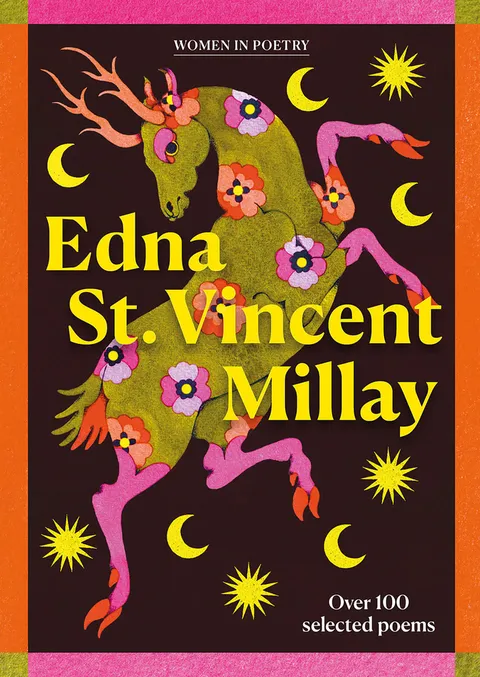
Explore the astonishing life and poetry of one of the most significant voices in American literature, Edna St. Vincent Millay
Luxury gift edition includes ribbon and sprayed edges
The volume offers an insight into the lyrical prowess of Edna St. Vincent Millay. With over 100 poems organised into thematic sections, exploring themes of death, grief, love, passion, individualism and the beauty found in nature.
Millay's writing, often ahead of its time, offers a timeless exploration of grief and the power of independence, making this collection essential for fans of feminist literature and poetry.
Curated by poet and literary critic Pelé Cox, readers are offered a greater understanding of the pioneering legacy of Millay as a talented poet, social reformer and independent woman.
Women in Poetry
Pairing powerful poems with illuminating literary criticism, Pelé Cox celebrates the work and lasting influence of some of the most important women in poetry. The perfect gift for literary lovers.
Edna St Vincent Millay
Edna St. Vincent Millay was born in 1892 in Rockland, Maine, the eldest of three daughters, and was encouraged by her mother to develop her talents for music and poetry. Her long poem "Renascence" won critical attention in an anthology contest in 1912 and secured for her a patron who enabled her to go to Vassar College.
After graduating in 1917 she lived in Greenwich Village in New York for a few years, acting, writing satirical pieces for journals (usually under a pseudonym), and continuing to work at her poetry. She traveled in Europe throughout 1921-22 as a "foreign correspondent" for Vanity Fair. Her collection A Few Figs from Thistles (1920) gained her a reputation for hedonistic wit and cynicism, but her other collections (including the earlier Renascence and Other Poems [1917]) are without exception more seriously passionate or reflective.
In 1923 she married Eugene Boissevain and -- after further travel -- embarked on a series of reading tours which helped to consolidate her nationwide renown. From 1925 onwards she lived at Steepletop, a farmstead in Austerlitz, New York, where her husband protected her from all responsibilities except her creative work. Often involved in feminist or political causes (including the Sacco-Vanzetti case of 1927), she turned to writing anti-fascist propaganda poetry in 1940 and further damaged a reputation already in decline. In her last years of her life she became more withdrawn and isolated, and her health, which had never been robust, became increasingly poor.
She died in 1950.
More by Edna St Vincent Millay








Why Readwise Books?
Readwise Books is an ebook & audiobook platform that automatically logs how much you and your friends read, making it fun and easy to read more. Learn more →