Report an issue
Tell us what's wrong and we'll take a look.
Thanks – we got it. We'll review and follow up if needed.
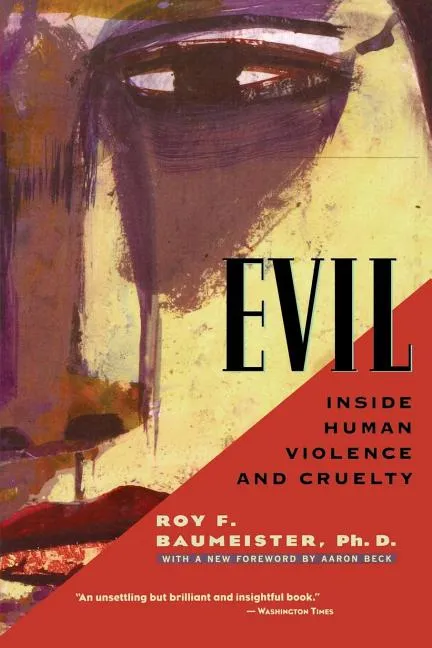
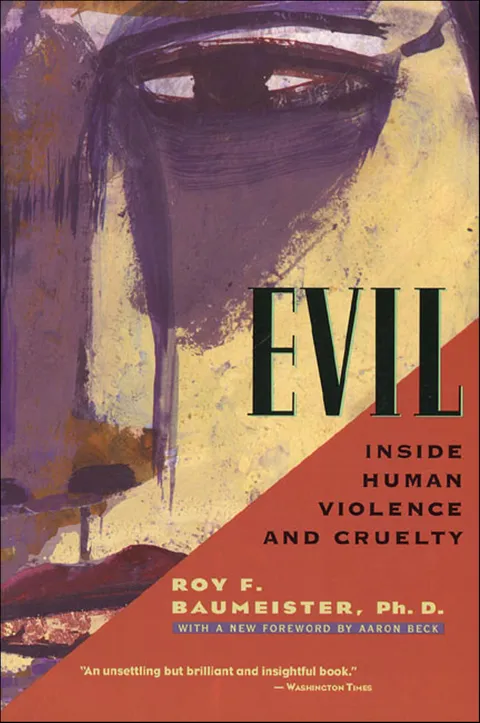
"A worthy synthesis both for victims who want to know why and for policymakers who need to know what to do" about violence in society (Scientific American). Why is there evil, and what can scientific research tell us about the origins and persistence of evil behavior? Considering evil from the unusual perspective of the perpetrator, Roy F. Baumeister asks, How do ordinary people find themselves beating their wives? Murdering rival gang members? Torturing political prisoners? Betraying their colleagues to the secret police? Why do cycles of revenge so often escalate? Baumeister casts new light on these issues as he examines the gap between the victim's viewpoint and that of the perpetrator, and also the roots of evil behavior, from egotism and revenge to idealism and sadism. A fascinating study of one of humankind's oldest problems, Evil has profound implications for the way we conduct our lives and govern our society. "Evidence from the disciplines of psychology, criminology, sociology, history and others is used to examine the roots of cruelty and violence, with historical and modern examples used to illustrate how modern people fall into patterns of violence." —Midwest Book Review
Roy F Baumeister
Roy F. Baumeister received his PhD in experimental social psychology in 1978 from Princeton. He has had a productive career with over 700 scientific publications, including 43 books. Scientific influence is measured by counting how often a researcher's work is cited in other scientific publications, and by that method, Baumeister is one of the most influential psychologists alive today. A 2022 comparison of 8.5 million scientists in the world, across all fields, ranked him #128, thus in the top 1% of the top 1% of all scientists. His book WILLPOWER: REDISCOVERING THE GREATEST HUMAN STRENGTH, co-authored with science journalist John Tierney, was a New York Times and Amazon bestseller. Much of his career has been spent tackling grand philosophical problems with social science data, such as in his books EVIL: INSIDE HUMAN VIOLENCE AND CRUELTY, MEANINGS OF LIFE, THE CULTURAL ANIMAL and THE SCIENCE OF FREE WILL. Over the years, he has held affiliations with diverse universities and institutes, including several in the U.S. (i.e., Harvard; Stanford; Florida State University; Case Western Reserve University; University of Virginia; University of Texas at Austin; University of California, Berkley; University of California, Santa Barbara) and several in other countries (i.e., University of Queensland, Australia; University of Bamberg, Germany; Jacobs University Bremen, Germany; Max-Planck-Institute, Germany; Free University of Amsterdam, The Netherlands; King Abdulaziz University, Saudi Arabia). In 2023, he received the Distinguished Scientist award from the Society for Experimental Social Psychology, and in 2014, he received the William James Fellow award from the Association for Psychological Science. He now lives in the mountains where he likes to take hikes with his small dog and ski in the winter. He also composes music on the piano.
More by Roy F Baumeister






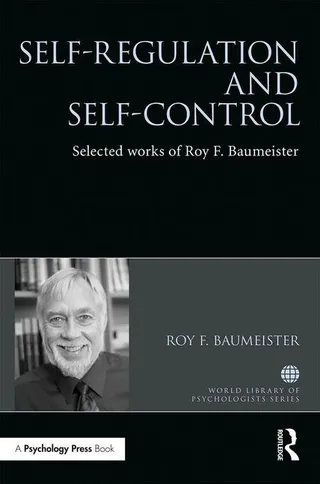

Aaron T. Beck
Aaron T. Beck, M.D., widely known as the father of cognitive therapy, was University Professor Emeritus at the University of Pennsylvania School of Medicine and president of the Beck Institute for Cognitive Therapy and Research. He graduated magna cum laude and Phi Beta Kappa from Brown University, and went on to attend Yale Medical School. He received more than 18 major professional awards from associations such as the National Institute of Mental Health, the American Psychiatric Association, the American Psychological Association, and the American Psychopathological Association.
More by Aaron T. Beck





Why Readwise Books?
Readwise Books is an ebook & audiobook platform that automatically logs how much you and your friends read, making it fun and easy to read more. Learn more →