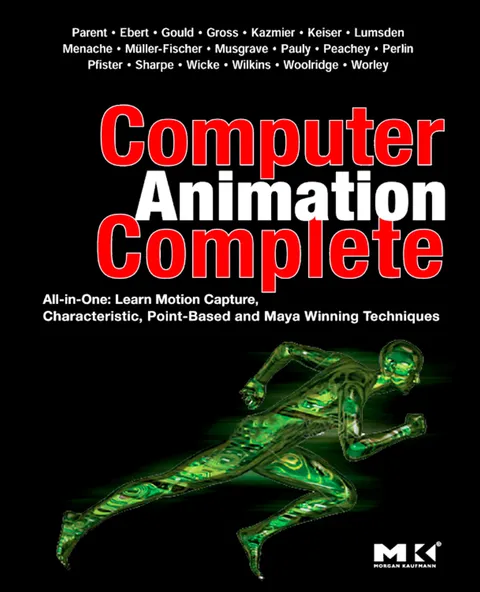
Computer Animation Complete
All-in-One: Learn Motion Capture, Characteristic, Point-Based, and Maya Winning Techniques
Report an issue
Tell us what's wrong and we'll take a look.
Thanks – we got it. We'll review and follow up if needed.
A compilation of key chapters from the top MK computer animation books available today - in the areas of motion capture, facial features, solid spaces, fluids, gases, biology, point-based graphics, and Maya. The chapters provide CG Animators with an excellent sampling of essential techniques that every 3D artist needs to create stunning and versatile images. Animators will be able to master myriad modeling, rendering, and texturing procedures with advice from MK's best and brightest authors.
Divided into five parts (Introduction to Computer Animation and Technical Background, Motion Capture Techniques, Animating Substances, Alternate Methods, and Animating with MEL for MAYA), each one focusing on specific substances, tools, topics, and languages, this is a MUST-HAVE book for artists interested in proficiency with the top technology available today! Whether you're a programmer developing new animation functionality or an animator trying to get the most out of your current animation software, Computer Animation Complete: will help you work more efficiently and achieve better results. For programmers, this book provides a solid theoretical orientation and extensive practical instruction information you can put to work in any development or customization project. For animators, it provides crystal-clear guidance on determining which of your concepts can be realized using commercially available products, which demand custom programming, and what development strategies are likely to bring you the greatest success.
- Expert instruction from a variety of pace-setting computer graphics researchers.
- Provides in-depth coverage of established and emerging animation algorithms.
- For readers who lack a strong scientific background, introduces the necessary concepts from mathematics, biology, and physics.
- A variety of individual languages and substances are addressed, but addressed separately - enhancing your grasp of the field as a whole while providing you with the ability to identify and implement solutions by category.
Rick Parent
Rick Parent is a Professor Emeritus in the Computer Science and Engineering Department of Ohio State University (OSU). As a graduate student, Rick worked at the Computer Graphics Research Group (CGRG) at OSU under the direction of Charles Csuri. In 1977, he received his Ph.D. from the Computer and Information Science (CIS) Department, majoring in Artificial Intelligence. For the next three years, he worked at CGRG first as a Research Associate, and then as Associate Director. In 1980 he co-founded and was President of The Computer Animation Company. In 1985, he joined the faculty of the CIS Department (now the Department of Computer Science and Engineering, or CSE) at Ohio State. Rick's research interests include various aspects of computer animation with special focus on animation of the human figure.
More by Rick Parent

David Gould
David Gould was born in Middlesex but moved to the Surrey countryside as a child. He now lives in East Grinstead, where he expects to end his days. At school, David's favourite subjects were English Language and History. On moving to East Grinstead, he compiled several books of old photographs of the town. His first (with the late Ronald Michell) was East Grinstead Then and Now, published in 1985. The former books have made considerable use of the photographs in the local museum's collection, to which he has unrestricted access as he has been for many years the voluntary Photographic Archivist.
More by David Gould









Markus Gross
Markus Gross is a professor of computer science and director of the Computer Graphics Laboratory of the Swiss Federal Institute of Technology (ETH) in Zürich. He received a master of science in electrical and computer engineering and a PhD in computer graphics and image analysis, both from the University of Saarbrucken, Germany. From 1990 to 1994, Dr. Gross worked for the Computer Graphics Center in Darmstadt, where he established and directed the Visual Computing Group. His research interests include point-based graphics, physics-based modeling, multiresolution analysis, and virtual reality. He has been widely publishing and lecturing on computer graphics and scientific visualization, and he authored the book Visual Computing (Springer, 1994). Dr. Gross has taught courses at major graphics conferences including ACM SIGGRAPH, IEEE Visualization, and Eurographics. He is the associate editor of the IEEE Computer Graphics and Applications and has served as a member of international program committees of many graphics conferences. Dr. Gross has been a papers co-chair of IEEE Visualization '99, Eurographics 2000, and IEEE Visualization 2002. He is chair of the papers committee of ACM SIGGRAPH 2005. Dr. Gross is a senior member of IEEE, a member of the IEEE Computer Society, a member of ACM and ACM Siggraph, and a member of the Eurographics Association. Dr. Gross is on the advisory boards of various international research institutes and governmental agencies. Dr Gross is a cofounder of Cyfex AG and Novodex AG.
More by Markus Gross
Chris Kazmier
Chris Kazmier is a senior technical director at Sony Pictures Imageworks, where he creates computer-generated effects for live-action films. He has worked on projects ranging from The Haunted Mansion to Sony's first all 3D feature animation Open Season. Previously, Chris worked at DreamWorks on Sinbad and at PDI/DreamWorks on the Intel Aliens ad campaign. Credits also include Fox Animation Studio's Titan AE and Anastasia.
Alberto Menache
Alberto Menache founded Three Space Imagery, Inc. (TSi), a computer graphics and video game developer, in Los Angeles, where he and his team developed proprietary software for motion capture usage in animation. After selling his software to Motion Analysis Corporation, Menache moved on to Pacific Data Images, a computer graphics industry leader, where he is the lead character technical director at the commercial and film effects division. His latest production credits include the film Forces of Nature, commercials for SEGA, Circle K and Pillsbury, the award-winning music video for TLC's "Waterfalls", and dozens of video games, including Dark Ridge, Messiah and Soul Blade.
More by Alberto Menache

F. Kenton Musgrave
F. Kenton Musgrave is CEO and CTO of Pandomeda, Inc., whose planet-building software product, MojoWorld, is the pinnacle of his research. He lectures internationally on fractals, computer graphics and the visual arts, and has developed digital effects for films such as Titanic and Apollo 13.











Darwyn Peachey
Darwyn Peachey is vice-president of Research and Development at Pixar Animation Studios. Prior to joining Pixar in 1988, Mr. Peachey was a member of the research staff at the University of Saskatchewan in Canada.
Hanspeter Pfister
Hanspeter Pfister is associate director and senior research scientist at MERL (Mitsubishi Electric Research Laboratories) in Cambridge, MA. He is the chief architect of VolumePro, Mitsubishi Electric's real-time volume rendering hardware for PCs. His research interests include computer graphics, scientific visualization, and graphics architectures. His work spans a range of topics, including point-based graphics, appearance modeling and acquisition, computational photography, 3D television, and face modeling. Hanspeter Pfister received his PhD in computer science in 1996 from the State University of New York at Stony Brook. He received his MS in electrical engineering from the Swiss Federal Institute of Technology (ETH) Zürich, Switzerland, in 1991. Dr. Pfister has taught courses at major graphics conferences including SIGGRAPH, IEEE Visualization, and Eurographics. He has been teaching introductory and advanced graphics courses at the Harvard Extension School since 1999. He is Associate Editor of the IEEE Transactions on Visualization and Computer Graphics (TVCG), chair of the IEEE Visualization and Graphics Technical Committee (VGTC), and has served as a member of international program committees of major graphics conferences. Dr. Pfister was the general chair of the IEEE Visualization 2002 conference. He is senior member of the IEEE, and member of ACM, ACM SIGGRAPH, the IEEE Computer Society, and the Eurographics Association.
Mark R Wilkins
Mark R. Wilkins is a technical director at DreamWorks Animation SKG, where he helped develop a production pipeline using Maya for effects and character animation. Mark also provides training and technical assistance to animators using Maya. He previously worked at Walt Disney Feature Animation in a variety of positions including software engineer and scene setup supervisor. He has contributed to a number of films, including Dinosaur, Mission: Impossible 2, Minority Report, and Madagascar. Mark holds a degree in physics from Harvey Mudd College.
Steve Worley
Steve Worley is an active researcher in graphics texturing, with experience in practical implementation of textures for use by other 3-D artists. He is the author of the popular Essence library of algorithmic textures.


Why Readwise Books?
Readwise Books is an ebook & audiobook platform that automatically logs how much you and your friends read, making it fun and easy to read more. Learn more →