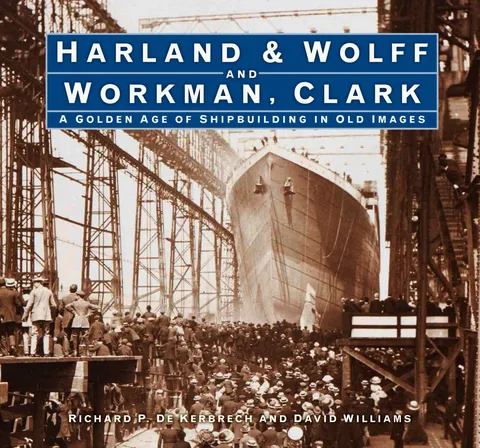
Harland & Wolff and Workman Clark
A Golden Age of Shipbuilding in Old Images
Report an issue
Tell us what's wrong and we'll take a look.
Thanks – we got it. We'll review and follow up if needed.
Once, the output of such yards as Harland & Wolff and Workman, Clark was vital business of national and international importance. The Harland & Wolff yard had a long association of building ships for the White Star Line, culminating in the three largest passenger vessels of the Edwardian era, Olympic, Titanic and Britannic, as well as others for the International Mercantile Marine Co.
This beautifully illustrated volume from Richard P. de Kerbrech and David L. Williams covers aspects of the construction and the skilled craftsmen that worked on these ships, and many others, from the Edwardian era to the 1920s, revelling in atmospheric views of the boiler shop, foundry, machine shop and slipways, as well as many successful launchings. The rich array of images showcases the labour-intensive heavy engineering and shipyard practices that were once part of Belfast's major industry, now sadly no more.
David Williams
David Williams was a writer best known for his crime-novel series featuring the banker Mark Treasure and police inspector DI Parry.
After serving as Naval Officer in the Second World War, Williams completed a History degree at St Johns College, Oxford before embarking on a career in advertising. He became a full-time fiction writer in 1978. Williams wrote twenty-three novels, seventeen of which were part of the Mark Treasure series of whodunnits which began with Unholy Writ (1976). His experience in both the Anglican Church and the advertising world informed and inspired his work throughout his career.
Two of Williams' books were shortlisted for the Crime Writers' Association Gold Dagger Award, and in 1988 he was elected to the Detection Club.
More by David Williams




Why Readwise Books?
Readwise Books is an ebook & audiobook platform that automatically logs how much you and your friends read, making it fun and easy to read more. Learn more →