Report an issue
Tell us what's wrong and we'll take a look.
Thanks – we got it. We'll review and follow up if needed.
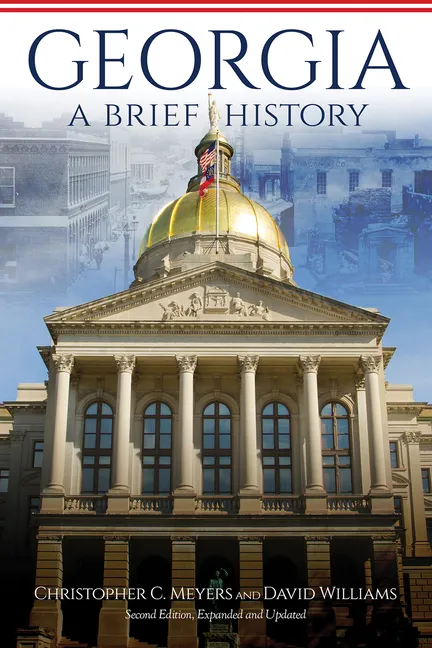
Overview: Here is a brief, balanced, and up-to-date history of Georgia from the early Native Americans into the twenty-first century. Based on the most recent research, this second edition surveys the people and events that shaped our state's history in a style that reads easily and flows effortlessly. Beginning with the earliest Native American settlements, the story tells of first contacts between area natives and Spanish from Florida, British from Carolina, and James Oglethorpe leading the effort to found a colony called Georgia. That colony passed out of the British Empire during the American Revolution, a conflict that was as much a civil war as a war for independence. In the following decades, the Creek and Cherokee were driven out as Georgia was transformed into a cotton kingdom dominated by a minority of slaveholders, who finally sought to make slavery perpetual in a war that often pitted Georgians against each other. In the aftermath of the Civil War, the state struggled with the consequences of the conflict, political, social, and economic. The postwar years were highlighted by economic stagnation, questions over the meaning of freedom, and one-party politics. Race relations pervaded the state's history after the Civil War and those struggles are traced from Reconstruction to Jim Crow to the Civil Rights Era and twenty-first century voter suppression. In the latter half of the twentieth century, and carrying into the twenty-first, Georgia drifted away from the provincialism that characterized its history and moved toward modernity.
Christopher C Meyers
Christopher C. Meyers is professor of American history at Valdosta State University. He has contributed articles to The Georgia Historical Quarterly, The Journal of Southwest Georgia History, Columbiad and edited a volume on Georgia history.
More by Christopher C Meyers
David Williams
David Williams was a writer best known for his crime-novel series featuring the banker Mark Treasure and police inspector DI Parry.
After serving as Naval Officer in the Second World War, Williams completed a History degree at St Johns College, Oxford before embarking on a career in advertising. He became a full-time fiction writer in 1978. Williams wrote twenty-three novels, seventeen of which were part of the Mark Treasure series of whodunnits which began with Unholy Writ (1976). His experience in both the Anglican Church and the advertising world informed and inspired his work throughout his career.
Two of Williams' books were shortlisted for the Crime Writers' Association Gold Dagger Award, and in 1988 he was elected to the Detection Club.
More by David Williams





Why Readwise Books?
Readwise Books is an ebook & audiobook platform that automatically logs how much you and your friends read, making it fun and easy to read more. Learn more →