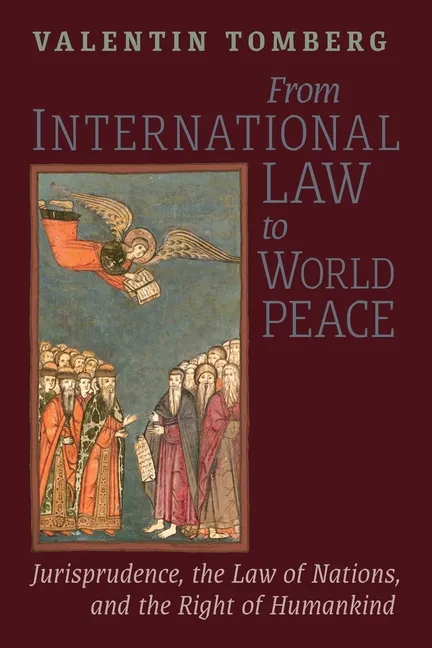
From International Law to World Peace
Jurisprudence, the Law of Nations, and the Right of Humankind Viewed in Philosophical-Historical Context
Report an issue
Tell us what's wrong and we'll take a look.
Thanks – we got it. We'll review and follow up if needed.
Valentin Tomberg's From International Law to World Peace was written in England in 1952, when the Cold War was becoming the determining political factor throughout the world. In our own time also we teeter on the brink of war and peace-we need only call to mind the present conflicts in Ukraine and Palestine. In short, the question of establishing world peace, and the role of international law in promoting it, is more relevant than ever. Tomberg examines with great clarity and insight the history of the jurisprudence of international law from its very beginnings in antiquity up to the middle of the twentieth century. He echoes the theme of his earlier work, The Art of the Good: The Regeneration of Fallen Justice, that the modern development of law consists in its gradual degeneration. Based on Thomas Aquinas's conception of law, he sees at the top of the legal edifice the eternal law that reveals itself in the world as divine law, as that itself underlies the natural law, which in turn evokes a sense of right and justice as a basic orientation for the positive law established by humankind. Tomberg does not limit himself, however, to justifying his thesis that these stages are no longer present in law-rather, he offers perspectives as to how the degenerative process he so exhaustively diagnoses can be counteracted by a regeneration of law. May the book in your hands contribute to meeting this challenge!
Valentin Tomberg
Valentin Tomberg (Feb. 27, 1900-Feb. 24, 1973) was born into a Lutheran family in St. Petersburg, Russia. As an adolescent, he was drawn to the hermetic Martinism of G.O.Mebes, as well as to Theosophy and the mysticism of Eastern Orthodoxy. Tomberg's mother was killed by looters during the Russian Revolution, after which Valentin and his father fled to Tallinn, Estonia, where Tomberg studied languages and comparative religion at the University of Tartu. As a young man, he was strongly influenced by Vladimir Soloviev and had a personal experience of the Sophia at a cathedral in Holland. In 1925, he joined the Anthroposophical Society, under whose auspices he lectured in Holland and England and wrote on his understanding of the Bible, Anthroposophy, and esoteric Christianity. During World War II, he left the Anthroposophical Society and its internal struggles and converted to Catholicism. In 1948, he moved to England, where he became a translator for the BBC and monitored Soviet broadcasts during the Cold War, while continuing his devotion to meditation practice and further writing on his esoteric insights. In 1960, he retired to Reading near the River Thames. He died while vacationing in Majorca. The best-known work of his later life is Meditations on the Tarot: A Journey into Christian Hermeticism, written anonymously.
More by Valentin Tomberg


Why Readwise Books?
Readwise Books is an ebook & audiobook platform that automatically logs how much you and your friends read, making it fun and easy to read more. Learn more →