Report an issue
Tell us what's wrong and we'll take a look.
Thanks – we got it. We'll review and follow up if needed.
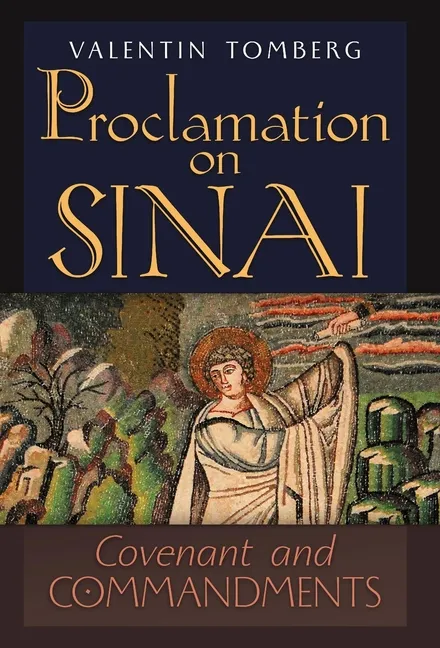
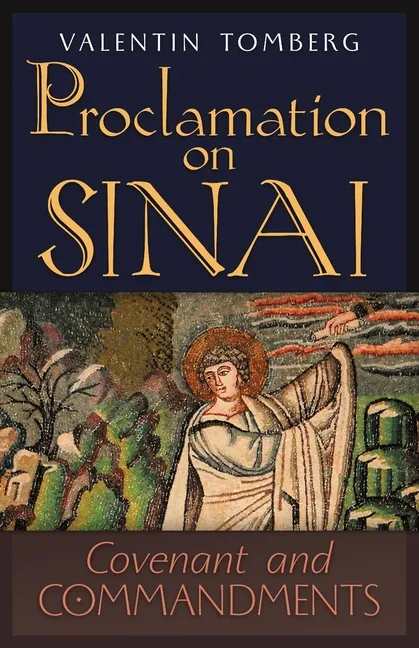
In his final years, Valentin Tomberg (1900-1973) completed three short works. The present book is the last of these. The first, Thy Kingdom Come: The New Evolution of the Good, and the second, Lazarus: The Miracle of Resurrection in World History, were published by Angelico Press in 2022. Why, towards the end of his life, after having already included a profound series of contemplations on the ten commandments in Letter XI of his magisterial Meditations on the Tarot: A Journey into Christian Hermeticism, did he return so intensively to this theme? Tomberg does not tell us directly, but the text itself suggests an answer. Here he looks back to major themes of the two phases of his life. The first of these themes, the origin of law (see his The Art of the Good: On the Regeneration of Fallen Justice), is discussed in this final book as a "path through the wilderness" such as he himself had to walk as a lifelong émigré (see Valentin Tomberg and the Ecclesia Universalis: A Biography). The second theme, the fundamental path of the soul in quest of personal certainty(see his Personal Certainty: On the Way, the Truth, and the Life, in press), he returns to as "essentialism," which he now approaches from the perspective of knowledge as an analogical process steeped in symbols: the Jewish kabbalah, the Decalogue, the Names of God, the Catholic church, the meaning of the papacy, and much else besides. The choirs of the spiritual hierarchies receive fresh appreciation, in association with reiterated respect for the life-work of Rudolf Steiner, with which he had been deeply aligned during the first half of his life. Finally, the "transfiguration of the dark clouds into light" on Mt. Sinai, as here portrayed, signals Tomberg's renewed immersion in what he calls the moral chronicle of the world, leading him to culminating insights into the origin of Divine Law from the vantage-point of his own "ascent of Sinai."
"In this deeply Christian esoteric work, Valentin Tomberg draws upon the wealth of his wisdom to elucidate the spiritual meaning of the Ten Commandments. One uniquely profound message of the book is that we are to honor our Father and our Mother, as she appears in her three aspects."-Harrie Salman, author of Valentin Tomberg and the Ecclesia Universalis: A Biography
"Every sentence of this extraordinary work makes clear that Valentin Tomberg wears the mantle of Moses for our time. His stunning combination of sweeping metahistorical insights with exact and exacting fine-grained historical commentary bring forth the Ten Commandments as living principles for right now."
-Kevin Dann, Contributing Editor, Public Domain Review
"This multivalent meditation on the Ten Commandments marries elements from Rudolf Steiner's insights (above all in terms of the angelic hierarchies) with Tomberg's profound embrace of Catholic tradition and dogma. Here an authentic Christian genius seeks to set us free from "the house of bondage" of our deterministic, desacralized age."-Roger Buck, Cor Jesu Sacratissimum: From Secularism and the New Age to Christendom Renewed
Valentin Tomberg
Valentin Tomberg (Feb. 27, 1900-Feb. 24, 1973) was born into a Lutheran family in St. Petersburg, Russia. As an adolescent, he was drawn to the hermetic Martinism of G.O.Mebes, as well as to Theosophy and the mysticism of Eastern Orthodoxy. Tomberg's mother was killed by looters during the Russian Revolution, after which Valentin and his father fled to Tallinn, Estonia, where Tomberg studied languages and comparative religion at the University of Tartu. As a young man, he was strongly influenced by Vladimir Soloviev and had a personal experience of the Sophia at a cathedral in Holland. In 1925, he joined the Anthroposophical Society, under whose auspices he lectured in Holland and England and wrote on his understanding of the Bible, Anthroposophy, and esoteric Christianity. During World War II, he left the Anthroposophical Society and its internal struggles and converted to Catholicism. In 1948, he moved to England, where he became a translator for the BBC and monitored Soviet broadcasts during the Cold War, while continuing his devotion to meditation practice and further writing on his esoteric insights. In 1960, he retired to Reading near the River Thames. He died while vacationing in Majorca. The best-known work of his later life is Meditations on the Tarot: A Journey into Christian Hermeticism, written anonymously.
More by Valentin Tomberg


Why Readwise Books?
Readwise Books is an ebook & audiobook platform that automatically logs how much you and your friends read, making it fun and easy to read more. Learn more →