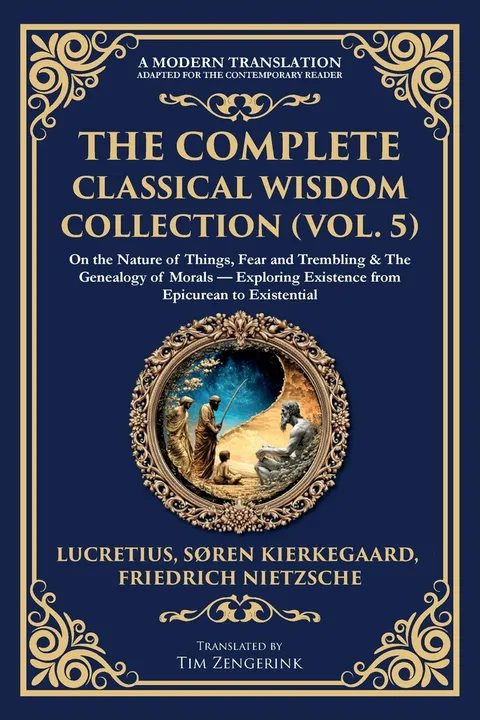
The Complete Classical Wisdom Collection (Vol. 5)
On the Nature of Things, Fear and Trembling & The Genealogy of Morals - Exploring Existence from Epicurean to Existential
Report an issue
Tell us what's wrong and we'll take a look.
Thanks – we got it. We'll review and follow up if needed.
The Complete Classical Wisdom Collection (Vol. 5) assembles three groundbreaking works that explore existence from radically different angles-Epicurean science, Christian existentialism, and Nietzschean critique. This modern translation makes their profound insights fully accessible, guiding readers through questions of reality, belief, and human nature.
What You'll Discover in This Modern Translation:
- On the Nature of Things by Lucretius - A poetic masterpiece of natural philosophy explaining the universe through atoms, void, and the rejection of fear-based superstition.
- Fear and Trembling by Søren Kierkegaard - A soul-searching examination of faith, sacrifice, and the torment of ethical paradoxes through the story of Abraham and Isaac.
- The Genealogy of Morals by Friedrich Nietzsche - A powerful deconstruction of morality, uncovering how guilt, punishment, and virtue have evolved through power struggles and resentment.
Together, these three works form a sweeping journey through Western thought-from the rational materialism of antiquity to the trembling uncertainty of belief and the fierce defiance of modernity.
Lucretius offers calm in understanding nature. Kierkegaard offers anguish in the demand for faith. Nietzsche offers fire in the destruction of illusion.
Whether you seek clarity in a chaotic world or wish to confront the deepest tensions of the human condition, this volume will leave you transformed.
Step into a conversation with the universe, with God, and with yourself.








Friedrich Nietzsche
Friedrich Nietzsche was a German philosopher and author. Born into a line of Protestant churchman, Nietzsche studied Classical literature and language before becoming a professor at the University of Basel in Switzerland. He became a philosopher after reading Schopenhauer, who suggested that God does not exist, and that life is filled with pain and suffering. Nietzsche’s first work of prominence was The Birth of Tragedy in 1872, which contained new theories regarding the origins of classical Greek culture. From 1883 to 1885 Nietzsche composed his most famous work, Thus Spake Zarathustra, in which he famously proclaimed that “God is dead.” He went on to release several more notable works including Beyond Good and Evil and The Genealogy of Morals, both of which dealt with the origins of moral values. Nietzsche suffered a nervous breakdown in 1889 and passed away in 1900, but not before giving us his most famous quote, “From life's school of war: what does not kill me makes me stronger.”
More by Friedrich Nietzsche





Why Readwise Books?
Readwise Books is an ebook & audiobook platform that automatically logs how much you and your friends read, making it fun and easy to read more. Learn more →