Report an issue
Tell us what's wrong and we'll take a look.
Thanks – we got it. We'll review and follow up if needed.
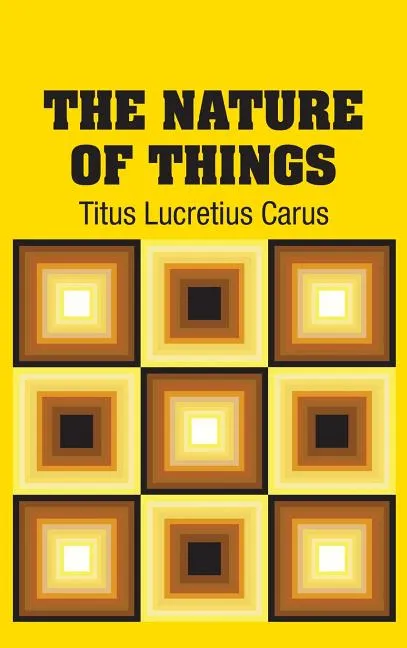
Titus Lucretius Carus was probably born in the early first century B.C., and died in the year 55. Little is known of his life, although two tantalizing bits of gossip were passed on by St. Jerome: that he was poisoned by a madness-inducing aphrodisiac given him by his wife, and that his great poem On the Nature of Things was posthumously edited by Cicero. For the latter assertion, writes Anthony Esolen in his introduction to the present volume, there is little evidence, and none whatsoever for the former.
What does survive is a masterful poetic work that stands as the greatest exposition of Epicurean philosophy. Writing in the waning days of the Roman Republic--as Rome's politics grew individualistic and treacherous, its high-life wanton, its piety introspective and morbid--Lucretius sets forth a rational and materialistic view of the world which offers a retreat into a quiet community of wisdom and friendship.
Even to modern readers, the sweep of Lucretius's observations is remarkable. A careful observer of nature, he writes with an innocent curiosity into how things are put together--from the oceans, lands, and stars to a mound of poppy seeds, from the "applause" of a rooster's wings to the human mind and soul. Yet Lucretius is no romantic. Nature is what it is--fascinating, purposeless, beautiful, deadly. Once we understand this, we free ourselves of superstitious fears, becoming as human and as godlike as we can be. The poem, then, is about the universe and how human beings ought to live in it. Epicurean physics and morality converge.
Until now, there has been no adequate English verse translation of Lucretius's work. Anthony Esolen fills that gap with a version that reproduces--with remarkable faithfulness--the meaning, pace, and tone of the original Latin.
Here is a book that will introduce a new generation of readers to a thinker whose powers of observation and depth of insight remain fresh to the present day.
"Esolen has the rare gift of being both a fine poet and a lover of languages. His diction is poetic and natural; he has a fine ear for sound, and the translation benefits greatly from being read aloud--as Latin poetry was meant to be. This translation is clear and forceful. It can, and will, be read."--Kenneth J. Reckford, University of North Carolina, Chapel Hill



Anthony Esolen
Translated by
Anthony Esolen is a Princeton graduate, the author or translator of thirty books (including Dante's Divine Comedy), and a regular contributor to Crisis Magazine, Chronicles, Touchstone, Magnificat, American Greatness, and Front Porch Republic. Dr. Esolen is widely praised as one of the best Catholic writers of our age. His engaging, conversational style opens eyes, engages minds, and changes hearts. He has been a professor of English since 1988. He and his wife Debra publish the web magazine Word and Song, designed, by means of linguistic history, music, art, classic poetry, and film, to bring to people daily encounters with what is beautiful, good, and true.


Why Readwise Books?
Readwise Books is an ebook & audiobook platform that automatically logs how much you and your friends read, making it fun and easy to read more. Learn more →