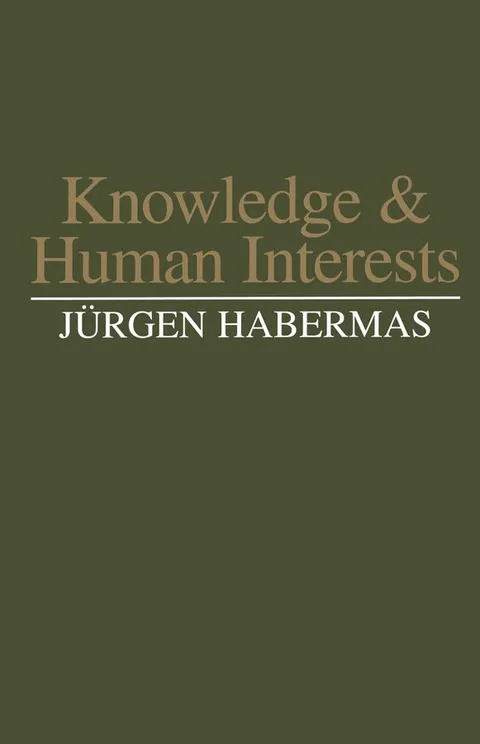
Knowledge and Human Interests
Report an issue
Tell us what's wrong and we'll take a look.
Thanks – we got it. We'll review and follow up if needed.
In this extraordinarily wide-ranging book, Habermas examines the principal positions of modern philosophy - Kantianism, Marxism, positivism, pragmatism, hermeneutics, the philosophy of science, linguistic philosophy and phenomenology - to lay bare the structure of the processes of enquiry that determine the meaning and the validity of all our statements which claim objectivity.
This edition contains a postscript written by Habermas for the second German edition of Knowledge and Human Interests.
Jürgen Habermas
J�rgen Habermas was born in 1929, and grew up in Gummersbach, Germany. He was educated at the Universities of Gottingen, Bonn, and Zurich, after which he worked for a while as a freelance journalist. In 1956 he became Adorno's assistant at the University of Frankfurt. From 1961 to 1964 he taught philosophy in Heidelberg, and from 1964 to 1971, philosophy and sociology in Frankfurt. From 1971 to 1983 he was Director of the Max Planck Institute for Research into the Life Conditions of the Scientific-Technical World, in Sternberg. Among his influential publications in English are: Knowledge and Human Interests (1971), Theory and Practice (1973), The Theory of Communicative Action (1984/1987), and Moral Consciousness and Communicative Action (1990).
More by Jürgen Habermas





Why Readwise Books?
Readwise Books is an ebook & audiobook platform that automatically logs how much you and your friends read, making it fun and easy to read more. Learn more →