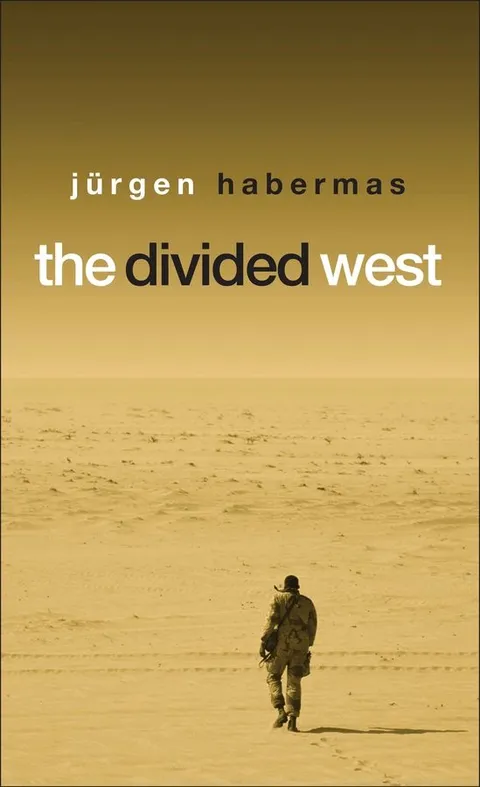
The Divided West
Report an issue
Tell us what's wrong and we'll take a look.
Thanks – we got it. We'll review and follow up if needed.
Make no mistake, the normative authority of the United States of America lies in ruins. Such is the judgment of the most influential thinker in Europe today reflecting on the political repercussions of the war in Iraq. The decision to go to war in Iraq, without the explicit backing of a Security Council Resolution, opened up a deep fissure in the West which continues to divide erstwhile allies and to hinder the attempt to develop a coordinated response to the new threats posed by international terrorism.
In this timely and important volume, Jurgen Habermas responds to the dramatic political events of the period since September 11, 2001, and maps out a way to move the political agenda forward, beyond the acrimonious debates that have pitched opponents of the war against the Bush Administration and its coalition of the willing. What is fundamentally at stake, argues Habermas, is the Kantian project of overcoming the state of nature between states through the constitutionalization of international law.
Habermas develops a detailed multidimensional model of transnational and supranational governance inspired by Kantian cosmopolitanism, situates it in the context of the evolution of international law toward a cosmopolitan constitutional order during the nineteenth and twentieth centuries, and defends it against the new challenge posed by the hegemonic liberal vision underlying the aggressive unilateralism of the current US administration.
The Divided West is a major intervention by one of the most highly regarded political thinkers of our time. It will be essential reading for students of sociology, politics, international relations, and international law, and it will be of great interest to anyone concerned with the current and future course of European and international politics.
Jürgen Habermas
J�rgen Habermas was born in 1929, and grew up in Gummersbach, Germany. He was educated at the Universities of Gottingen, Bonn, and Zurich, after which he worked for a while as a freelance journalist. In 1956 he became Adorno's assistant at the University of Frankfurt. From 1961 to 1964 he taught philosophy in Heidelberg, and from 1964 to 1971, philosophy and sociology in Frankfurt. From 1971 to 1983 he was Director of the Max Planck Institute for Research into the Life Conditions of the Scientific-Technical World, in Sternberg. Among his influential publications in English are: Knowledge and Human Interests (1971), Theory and Practice (1973), The Theory of Communicative Action (1984/1987), and Moral Consciousness and Communicative Action (1990).
More by Jürgen Habermas





Why Readwise Books?
Readwise Books is an ebook & audiobook platform that automatically logs how much you and your friends read, making it fun and easy to read more. Learn more →