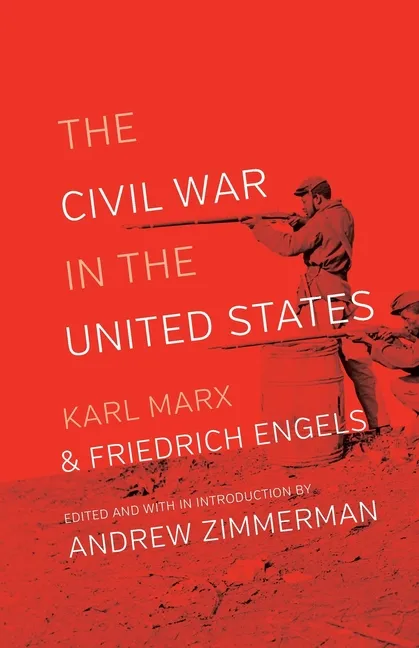
The Civil War in the United States
Report an issue
Tell us what's wrong and we'll take a look.
Thanks – we got it. We'll review and follow up if needed.
Readers will not find a Marxist interpretation of the American Civil War laid out in this volume. Rather, they will observe Marx and Engels working to define their own approach to history and politics while analyzing the American Civil War as it developed into the greatest social revolution that the United States has so far achieved.
Radicals and revolutionaries found themselves in a complex political position at the outbreak of the American Civil War of 1861-65. They demanded a war against slavery as an evil in itself and as the root cause of the Confederate rebellion, but the Lincoln administration proclaimed it fought only to preserve the Union and would not interfere with slavery in the states where it already existed. "All knew," in the words of Lincoln's 1864 second inaugural address, that slavery "was somehow the cause of the war," but if, and to what extent, the war would end slavery and transom the country that had grown wealthy from the labor of four million enslaved African Americans remained an open question.
By the time the war ended in 1865, the radicals and revolutionaries got their way, thanks in large part to the actions of the enslaved themselves, and the North thus won a war that had also become a revolution against slavery.
Karl Marx
Karl Marx was born in 1818, in the Rhenish city of Trier, the son of a successful lawyer. He studied law and philosophy at the universities of Bonn and Berlin, completing his doctorate in 1841. In Paris three years later, Marx was introduced to the study of political economy by a former fellow student, Frederick Engels. In 1848 they collaborated in writing The Communist Manifesto. Expelled from Prussia in the same year, Marx took up residence first in Paris and then in London where, in 1867 he published his magnum opus Capital. A co-founder of the International Workingmen's Association in 1864, Marx died in London in 1883.
More by Karl Marx

Friedrich Engels
Friedrich Engels (1820–1895) was a German philosopher and co-author of The Communist Manifesto alongside Karl Marx. Born in Barmen, Prussia, Engels played a crucial role in shaping Marxist theory. His works, including The Condition of the Working Class in England, explored class struggles and historical materialism. As a committed socialist, Engels contributed significantly to the foundations of modern communist thought, leaving a lasting impact on political philosophy and social theory.
More by Friedrich Engels




Why Readwise Books?
Readwise Books is an ebook & audiobook platform that automatically logs how much you and your friends read, making it fun and easy to read more. Learn more →