Report an issue
Tell us what's wrong and we'll take a look.
Thanks – we got it. We'll review and follow up if needed.
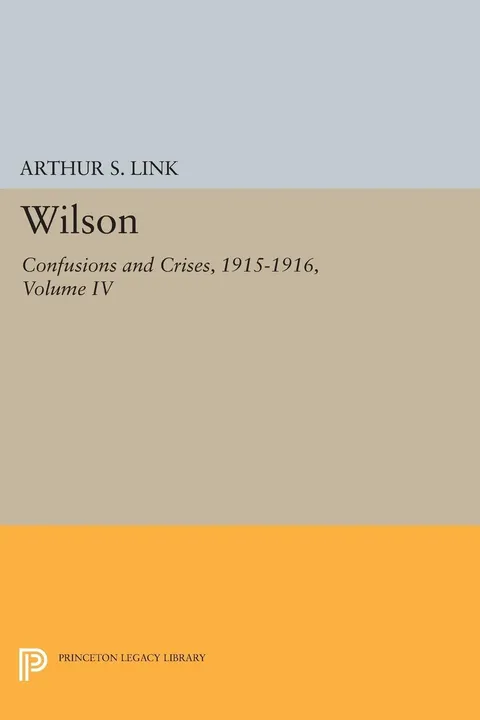
The fourth volume of Mr. Link's biography of Woodrow Wilson and the history of his times covers the period from autumn 1915 to spring 1916. Since this was a time of extreme domestic political controversy and recurring crises with Mexico and Germany, the volume has no single theme. Mr. Link describes fully the negotiation of the House-Grey memorandum and European reaction to it; the armed ship controversy; the Sussex crisis; and the events that nearly led to war with Mexico in 1916. Materials found in German, British, and French archives and manuscript collections are used, as well as from American sources.
Originally published in 1964.
The Princeton Legacy Library uses the latest print-on-demand technology to again make available previously out-of-print books from the distinguished backlist of Princeton University Press. These editions preserve the original texts of these important books while presenting them in durable paperback and hardcover editions. The goal of the Princeton Legacy Library is to vastly increase access to the rich scholarly heritage found in the thousands of books published by Princeton University Press since its founding in 1905.
Woodrow Wilson
Thomas Woodrow Wilson, born to Joseph Ruggles Wilson and Jessie Janet Woodrow, was a political leader and academic who served as the 28th president of the United States from 1913 to 1921. Before his presidency, he was a prominent scholar and served as president of Princeton University, where he emphasized educational reform and academic excellence. Later, as governor of New Jersey, he became known for progressive legislative achievements that raised his national profile. A key figure of the Democratic Party, he won the 1912 presidential election by promoting a platform of reform called the New Freedom, which sought to tackle monopolies and strengthen individual rights. His presidency included significant legislative accomplishments such as the Federal Reserve Act and the Clayton Antitrust Act. During World War I, he initially kept the U.S. neutral but ultimately led the nation into the conflict, framing it as a fight to make the world safe for democracy. After the war, he championed the League of Nations, although the U.S. Senate rejected its membership. His later years were marked by declining health following a severe stroke in 1919, and he remained physically incapacitated for much of his final term. He died in 1924.
More by Woodrow Wilson









Why Readwise Books?
Readwise Books is an ebook & audiobook platform that automatically logs how much you and your friends read, making it fun and easy to read more. Learn more →