Report an issue
Tell us what's wrong and we'll take a look.
Thanks – we got it. We'll review and follow up if needed.
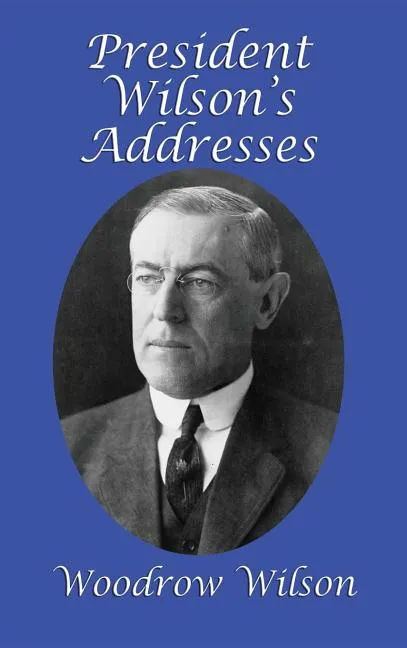
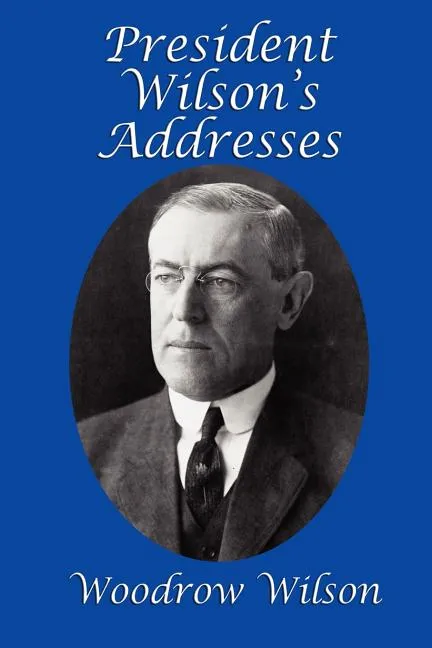
These addresses of President Woodrow Wilson are almost entirely concerned with political affairs, and more specifically with defining Americanism. Yet they also show that even as he moved from academia to the heights of politics, Wilson retained something of the teacher's interest in showing the relation between specific instances and the general forms of thought or action of which they are a part. Not fact alone, but principle, is what he sought to discover to his audiences.
Some of the addresses are state papers, read to Congress, and were carefully composed. Others, delivered in various places, appear to have been more or less extemporaneous. All are full of Wilson's political philosophy, and many of them contain expressions of his opinions on general subjects, such as personal character and conduct. To be a literary artist, a writer must possess a constructive imagination. He must be a man of feeling and have the gift of imparting to others some share of his own emotions. On almost every page of President Wilson's writings, as in almost all his policies, whether educational or political, is stamped the evidence of shaping, visionary power.
Woodrow Wilson was born in Virginia in 1856, and earned his Ph.D. in history and political science from Johns Hopkins University. In 1890, he was appointed a professor of jurisprudence and political economy at Princeton University, and in 1902, he was named the 13th president of the university. In 1910, he was elected the 34th Governor of New Jersey, and left Princeton for that post. Two years later, he won the Democratic nomination for President of the United States. Following Theodore Roosevelt's splitting of the Republican Party, Wilson was elected the 28th President with 42% of the popular vote, and 82% of the electoral vote. In 1916, he was re-elected, becoming the first Democratic President to serve two consecutive terms since Andrew Jackson (1829-37). Following the end of World War I, Wilson traveled to the Paris Peace Conference, spending four months in Europe. Though he was unsuccessful in getting the US to join his proposed League of Nations, Wilson was awarded the Nobel Peace Prize for his efforts in 1919. In October 1919, he suffered a massive stroke which incapacitated him for six months (during which time his second wife, Edith, was presumably acting President). Wilson recovered somewhat, retired from the Presidency in 1921, and died at home in Washington, DC, in 1924.
Woodrow Wilson
Thomas Woodrow Wilson, born to Joseph Ruggles Wilson and Jessie Janet Woodrow, was a political leader and academic who served as the 28th president of the United States from 1913 to 1921. Before his presidency, he was a prominent scholar and served as president of Princeton University, where he emphasized educational reform and academic excellence. Later, as governor of New Jersey, he became known for progressive legislative achievements that raised his national profile. A key figure of the Democratic Party, he won the 1912 presidential election by promoting a platform of reform called the New Freedom, which sought to tackle monopolies and strengthen individual rights. His presidency included significant legislative accomplishments such as the Federal Reserve Act and the Clayton Antitrust Act. During World War I, he initially kept the U.S. neutral but ultimately led the nation into the conflict, framing it as a fight to make the world safe for democracy. After the war, he championed the League of Nations, although the U.S. Senate rejected its membership. His later years were marked by declining health following a severe stroke in 1919, and he remained physically incapacitated for much of his final term. He died in 1924.
More by Woodrow Wilson



Why Readwise Books?
Readwise Books is an ebook & audiobook platform that automatically logs how much you and your friends read, making it fun and easy to read more. Learn more →