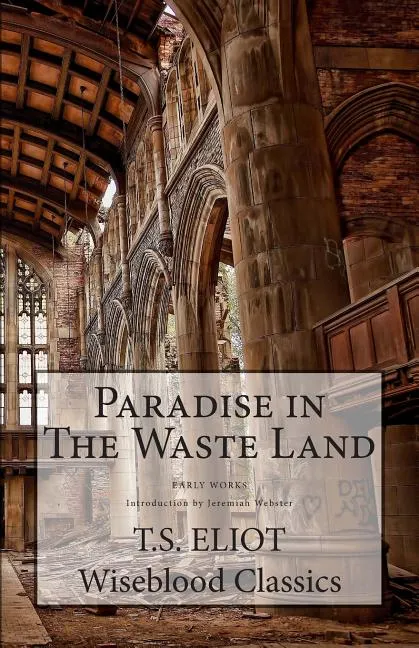
Paradise in The Waste Land
Report an issue
Tell us what's wrong and we'll take a look.
Thanks – we got it. We'll review and follow up if needed.
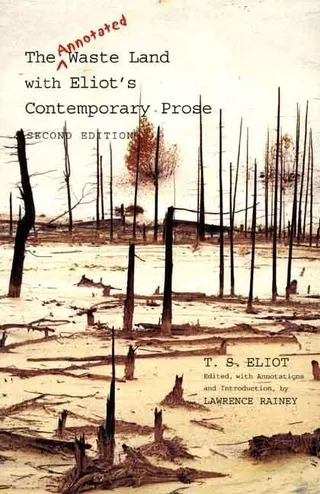
"Jeremiah Webster's brilliant Introduction leaves no doubt about Eliot's relevance for a new generation of readers." -Lee Oser, author of T.S. Eliot and American Poetry and The Ethics of Modernism: Moral Ideas in Yeats, Eliot, Joyce, Woolf and Beckett Dr Webster's introduction offers compelling reasons for experienced readers to revisit Eliot, and powerful incentives for new readers to explore the landscape of this immeasurably influential artist. -Dr. E Victor Bobb, Whitworth University . . . Eliot's poetry deserves a new readership. As the United States continues to seek departed nymphs through the incantations of technology, as moral impotence becomes the norm, the jeremiad voice of The Waste Land is a much needed corrective; its pessimism may in fact be the best prescription for our time. Eliot's critique of Victorian decay, of the bankruptcy of empire, "Falling towers / Jerusalem Athens Alexandria / Vienna London / Unreal," is a necessary rejoinder for a generation still trying to maintain a Post-WWII "American Dream." As prosperity becomes increasingly mirage-like in the Twenty First Century, as decadence begets debt, as shalom is pursued through duplicitous governance and predator drones, the poem's final lamentation, "Shantih, Shantih, Shantih," is an apt benediction for our age. To survey this "heap of broken images" as Eliot so courageously does, is to recognize that all is not well, that unless there is revelation, "the sound of water over a rock," unless we are able to answer, "Who is the third who walks always beside you?," there is little reason for hope. -From the Introduction by Jeremiah Webster Wiseblood Books is a publishing line particularly favorable toward works of fiction, poetry, and philosophy that render truths with what Flannery O'Connor called an unyielding "realism of distances." Such works find redemption in uncanny places and people; wrestle us from the tyranny of boredom; mock the pretensions of respectability; engage the hidden mysteries of the human heart, be they sources of either violence or courage; articulate faith and doubt in their incarnate complexity; dare an unflinching gaze at human beings as "political animals"; and suffer through this world's trials without forfeiting hope. Visit us at www.wisebloodbooks.com We are wide-eyed for new epiphanies of beauty.
T S Eliot
T. S. Eliot (1888–1965) was born in St. Louis, Missouri. He moved to England in 1914 and published his first book of poems in 1917. Eliot received the Nobel Prize in Literature in 1948 and is best known for his masterpiece The Waste Land. Eliot died in 1965.
More by T S Eliot









Why Readwise Books?
Readwise Books is an ebook & audiobook platform that automatically logs how much you and your friends read, making it fun and easy to read more. Learn more →