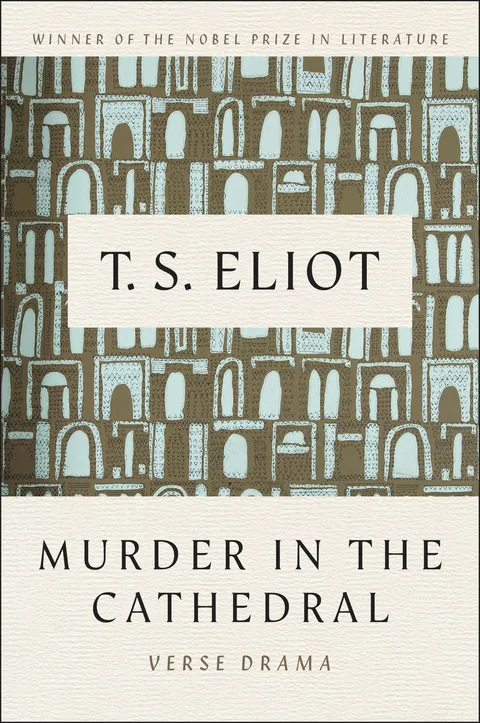
Murder in the Cathedral
Report an issue
Tell us what's wrong and we'll take a look.
Thanks – we got it. We'll review and follow up if needed.
T. S. Eliot’s most famous verse drama, a retelling of the murder of the archbishop of Canterbury
Murder in the Cathedral, written for the Canterbury Festival in 1935, was one of T. S. Eliot’s first dramatic achievements, and it remains one of the great plays of the century. It takes as its subject matter the martyrdom of Thomas Becket, Archbishop of Canterbury, depicting the political intrigue and events that led to his assassination, in his own cathedral church, by the knights of Henry II in 1170. Like Greek drama, the play’s theme and form are rooted in religion, ritual purgation and renewal, and it was this return to the earliest sources of drama that brought poetry triumphantly back to the English stage at the time.
"The theatre is enriched by this poetic play of grave beauty and momentous decision." —The New York Times
When a king’s ambition clashes with God’s will, where does a man’s true loyalty lie?
- Historical Drama: Experience the fatal clash between Archbishop Thomas Becket and King Henry II, a conflict of church and state that culminates in the archbishop’s 1170 assassination inside Canterbury Cathedral.
- Spiritual Temptation: Witness Becket’s internal struggle as four tempters challenge his resolve, forcing him to confront the ultimate treason: doing the right deed for the wrong reason.
- Inspired by Greek Tragedy: Discover a play structured like a classical drama, complete with a Chorus of Canterbury women who comment on the action and give voice to the fears of the common people.
- Lyrical Verse: Immerse yourself in the powerful, poetic language of T. S. Eliot, which brought verse triumphantly back to the modern English stage.
T. S. Eliot
T. S. Eliot, a poet, critic, and publisher, was born in St. Louis, Missouri, in 1888. He settled in England in 1915, where for a few years he worked in the foreign section of Lloyds Bank. His first book of poems, Prufrock and Other Observations, was published in 1917. In 1922, he became editor of the literary journal The Criterion, publishing The Waste Land in its first outing. In 1925 Eliot was recruited by Geoffrey Faber to be the literary editor and a director of a new publishing house, Faber and Gwyer (later Faber and Faber). It was a role in which he excelled, going on to establish Faber as a leading publisher of poetry with a list that embraced the outstanding English-language poets of the twentieth century. Eliot received the Nobel Prize in Literature in 1948. He continued to work at Faber until his death in 1965.
More by T. S. Eliot









Why Readwise Books?
Readwise Books is an ebook & audiobook platform that automatically logs how much you and your friends read, making it fun and easy to read more. Learn more →