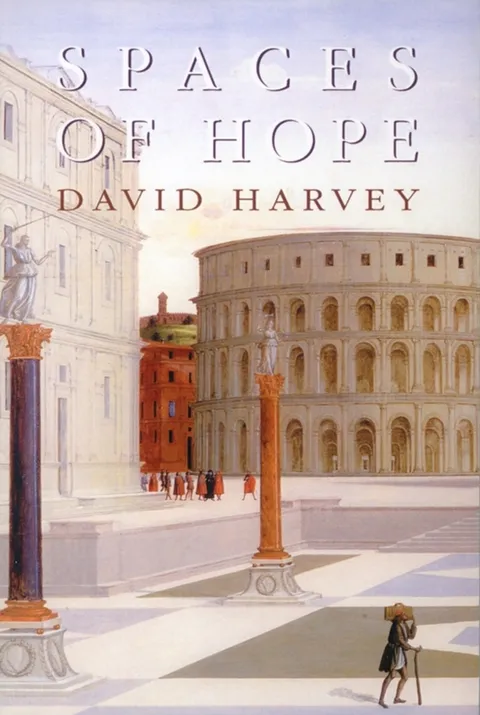
Spaces of Hope
Report an issue
Tell us what's wrong and we'll take a look.
Thanks – we got it. We'll review and follow up if needed.
As the twentieth century drew to a close, the rich were getting richer; power was concentrated within huge corporations; vast tracts of the earth were being laid waste: three-quarters of the world's population had no control of its destiny and no claim to basic rights. There was nothing new in this. What was new was the virtual absence of any political will to do anything about it. Spaces of Hope takes issue with this. David Harvey brings an exciting perspective to two of the principal themes of contemporary social discourse; globalization and the body. Exploring the uneven geographical development of late twentieth-century capitalism, and the working body in relation to this new geography of production and consumption, he finds in Marx's writings a wealth of relevant analysis and theoretical insight. In order to make much needed changes, he maintains, we need to become the architects of a different living and working environment and learn to bridge the micro-scale of the body and the personal and the macro-scale of global political economy. Utopian movements have for centuries tried to construct a just society. David Harvey looks at their history to ask why they failed and what the ideas behind them might still have to offer. His devastating description of the existing urban environment (Baltimore is his case study) fuels his argument that we can and must use the force of utopian imagining against all who say 'there is no alternative'. He outlines a new kind of utopian thought, which he calls 'dialectical utopianism' and refocuses our attention on possible designs for a more equitable world of work and living with nature. If any political ideology or plan is to work, he argues, it must take account of our human qualities, the capacities and powers inherent in nature, and the dynamics of change. Finally, Harvey dares to sketch a very personal utopian vision in an appendix, one that leaves no doubt about his own geography of hope.
David Harvey
David Harvey teaches at the Graduate Center of the City University of New York and is the author of many books, including Social Justice and the City, The Condition of Postmodernity, The Limits to Capital, A Brief History of Neoliberalism, Spaces of Global Capitalism, and A Companion to Marx's Capital. His website is http://davidharvey.org
More by David Harvey




Why Readwise Books?
Readwise Books is an ebook & audiobook platform that automatically logs how much you and your friends read, making it fun and easy to read more. Learn more →