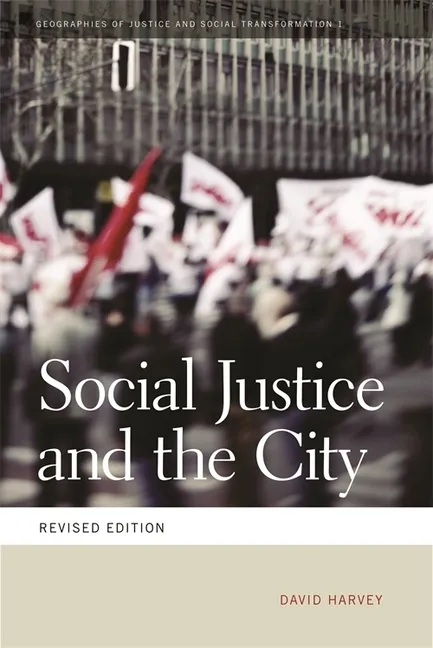
Social Justice and the City
Report an issue
Tell us what's wrong and we'll take a look.
Thanks – we got it. We'll review and follow up if needed.
Throughout his distinguished and influential career, David Harvey has defined and redefined the relationship between politics, capitalism, and the social aspects of geographical theory. Laying out Harvey's position that geography could not remain objective in the face of urban poverty and associated ills, Social Justice and the City is perhaps the most widely cited work in the field.
Harvey analyzes core issues in city planning and policy--employment and housing location, zoning, transport costs, concentrations of poverty--asking in each case about the relationship between social justice and space. How, for example, do built-in assumptions about planning reinforce existing distributions of income? Rather than leading him to liberal, technocratic solutions, Harvey's line of inquiry pushes him in the direction of a "revolutionary geography," one that transcends the structural limitations of existing approaches to space. Harvey's emphasis on rigorous thought and theoretical innovation gives the volume an enduring appeal. This is a book that raises big questions, and for that reason geographers and other social scientists regularly return to it.
David Harvey
David Harvey teaches at the Graduate Center of the City University of New York and is the author of many books, including Social Justice and the City, The Condition of Postmodernity, The Limits to Capital, A Brief History of Neoliberalism, Spaces of Global Capitalism, and A Companion to Marx's Capital. His website is http://davidharvey.org
More by David Harvey






Why Readwise Books?
Readwise Books is an ebook & audiobook platform that automatically logs how much you and your friends read, making it fun and easy to read more. Learn more →