Report an issue
Tell us what's wrong and we'll take a look.
Thanks – we got it. We'll review and follow up if needed.
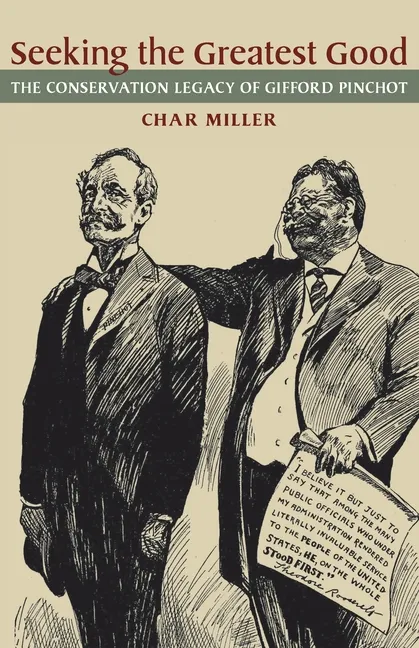
President John F. Kennedy officially dedicated the Pinchot Institute for Conservation Studies on September 24, 1963 to further the legacy and activism of conservationist Gifford Pinchot (1865-1946). Pinchot was the first chief of the United States Forest Service, appointed by Theodore Roosevelt in 1905. During his five-year term, he more than tripled the national forest reserves to 172 million acres. A pioneer in his field, Pinchot is widely regarded as one of the architects of American conservation and an adamant steward of natural resources for future generations.
Author Char Miller highlights many of the important contributions of the Pinchot Institute through its first fifty years of operation. As a union of the United States Forest Service and the Conservation Foundation, a private New York-based think tank, the institute was created to formulate policy and develop conservation education programs. Miller chronicles the institution's founding, a donation of the Pinchot family, at its Grey Towers estate in Milford, Pennsylvania. He views the contributions of Pinchot family members, from the institute's initial conception by Pinchot's son, Gifford Bryce Pinchot, through the family's ongoing participation in current conservation programming. Miller describes the institute's unique fusion of policy makers, scientists, politicians, and activists to increase our understanding of and responses to urban and rural forestry, water quality, soil erosion, air pollution, endangered species, land management and planning, and hydraulic franking.
Miller explores such innovative programs as Common Waters, which works to protect the local Delaware River Basin as a drinking water source for millions; EcoMadera, which trains the residents of Cristobal Col—n in Ecuador in conservation land management and sustainable wood processing; and the Forest Health-Human Health Initiative, which offers health-care credits to rural American landowners who maintain their carbon-capturing forestlands. Many of these individuals are age sixty-five or older and face daunting medical expenses that may force them to sell their land for timber.
Through these and countless other collaborative endeavors, the Pinchot Institute has continued to advance its namesake's ambition to protect ecosystems for future generations and provide vital environmental services in an age of a burgeoning population and a disruptive climate.
Char Miller
Char Miller, formerly a professor of history at Trinity University, is the W. M. Keck Professor of Environmental Analysis at Pomona College. He is the author of the award-winning Gifford Pinchot and the Making of Modern Environmentalism, Deep in the Heart of San Antonio: Land and Life in South Texas, and Public Lands/Public Debates: A Century of Controversy, as well as the editor of On the Border: An Environmental History of San Antonio and Fifty Years of the Texas Observer. His most recent books for Trinity University Press are Not So Golden State: Sustainability vs. the California Dream and On the Edge: Water, Immigration, and Politics in the Southwest. Miller is a frequent contributor to print, electronic, and social media.
More by Char Miller



Why Readwise Books?
Readwise Books is an ebook & audiobook platform that automatically logs how much you and your friends read, making it fun and easy to read more. Learn more →