Report an issue
Tell us what's wrong and we'll take a look.
Thanks – we got it. We'll review and follow up if needed.
From Madonna to Deepak Chopra, celebrities have been recording and embracing Rumi's poetry for the past two decades, creating a resurgence of interest in this 13th century Sufi mystic.
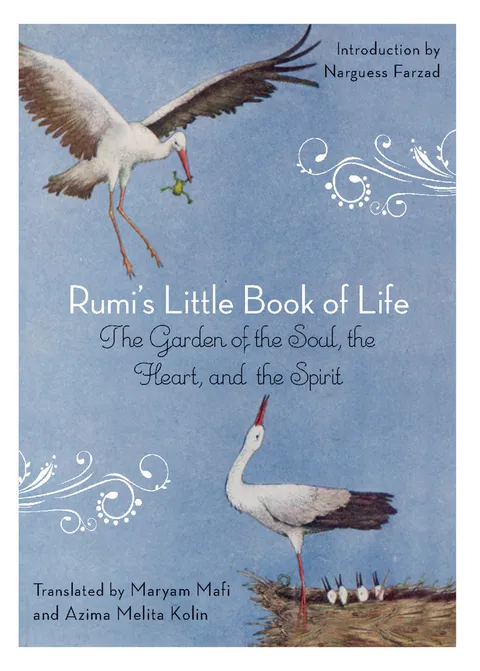
Rumi's Little Book of Life is a beautiful collection of 196 poems by Rumi, previously unavailable in English. Translated by native Persian speakers, Maryam Mafi and Azima Melita Kolin, this collection will appeal to Rumi lovers everywhere.
This collection of mystical poetry focuses on one of life's core issues: coming to grips with the inner life. During the course of life, each of us is engaged on an inner journey. Rumi's Little Book of Life is a guidebook for that journey. The poetry is a companion for those who consciously enter the inner world to explore the gardens within--out of the everyday "world of dust"--through an ascending hierarchy that restores one's soul to the heart; the heart of the spirit; and in finding spirit, transcending all.
Rumi
"Rumi (30 September 1207 - 17 December 1273), was a 13th-century Persian poet, Hanafi faqih, Islamic scholar, Maturidi theologian and Sufi mystic originally from Greater Khorasan in Greater Iran. Rumi's influence transcends national borders and ethnic divisions: Iranians, Tajiks, Turks, Greeks, Pashtuns, other Central Asian Muslims, as well as Muslims of the Indian subcontinent have greatly appreciated his spiritual legacy for the past seven centuries. His poems have been widely translated into many of the world's languages and transposed into various formats. Rumi has been described as the ""most popular poet"" and the ""best selling poet"" in the United States.Rumi's works are written mostly in Persian, but occasionally he also used Turkish, Arabic and Greek in his verse. His Masnavi (Mathnawi), composed in Konya, is considered one of the greatest poems of the Persian language. His works are widely read today in their original language across Greater Iran and the Persian-speaking world. Translations of his works are very popular, most notably in Turkey, Azerbaijan, the United States and South Asia. His poetry has influenced not only Persian literature, but also the literary traditions of the Ottoman Turkish, Chagatai, Urdu, Bengali and Pashto languages."
More by Rumi


Why Readwise Books?
Readwise Books is an ebook & audiobook platform that automatically logs how much you and your friends read, making it fun and easy to read more. Learn more →