In Search of Lost Time
Report an issue
Tell us what's wrong and we'll take a look.
Thanks – we got it. We'll review and follow up if needed.
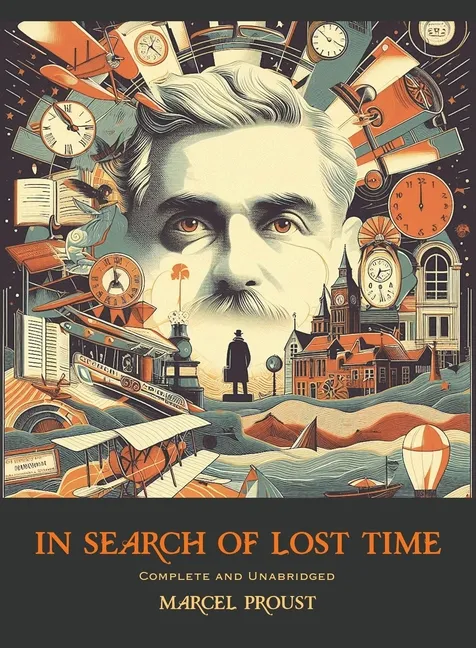
Through seven volumes, the narrator of In Search of Lost Time recounts his memories as they occur to him. An innocuous treat-say, a small cake paired with a cup of tea-may awaken memories buried deep within the narrator's mind; memories cause more memories to surface. Like the cathedral builders of old, a whole life and the world around it are thus formed anew, slowly and methodically, by uniting pieces of the narrator's life for the sake of the reader.
This recollection takes us through the narrator's childhood, weaving the social web his family finds itself entangled in, his first crush and coming of age, his gradual appreciation of art while finding his place into society, his hurtful obsession over a young woman, and, ultimately, the consolation that what had been lost in his youth can be regained.
Firmly grounded in Modernism, In Search of Lost Time is not a work about memories but memory. By leading the reader in circles, sometimes on a glorious wild goose chase, Proust holds a mirror in front of the reader, sending us back to our own memories and experiences, no matter how pleasant or uncomfortable. By its very nature, it's a difficult exercise about one of the defining features of humanity: our ability to manipulate time by recalling and, often, recreating it.
C. K. Scott Moncrieff's English translation is as highly regarded as the novel itself. Moncrieff used Remembrance of Things Past as the title, which was not a translation of the French title but a quote from a Shakespearean sonnet; this edition uses the translated title that the work is best known by in English. Just as Proust passed away before finalizing the last three volumes, so Moncrieff passed away before completing his translation; the final volume was translated by his (and Proust's) friend Sydney Schiff, under the pseudonym Stephen Hudson.
Only the first five translated volumes are currently available in the public domain. The remaining two will be added to this edition after their copyrights expire over the next two years.
The first-person account of a man's introspections on his life and examination of memory.
The source for this public-domain ebook is Standard Ebooks (standardebooks.org). Ebooks from other sources often have typos, inconsistent spelling, missing accent marks, and missing punctuation. Ebooks from Standard Ebooks are proofread line by line against a scan of the original printed pages, then proofread again from cover to cover. They are also formatted and typeset following a professional-grade style manual, resulting in new editions supporting state-of-the-art ereader technology: automatic hyphenation, popup footnotes, complete and consistent metadata, high-resolution and scalable vector graphics, and ereader-compatible tables of contents. All of this makes the finished ebooks accurate, functional, and beautiful, a pleasure to read. (Waking Lion Press is not affiliated with or endorsed by Standard Ebooks.)
Marcel Proust
Marcel Proust transformed memory into art, revealing how time and experience shape the inner life. Born in 1871 in France, he lived much of his later life in relative isolation, devoted entirely to writing. A fascination with memory, perception, and the passage of time guided his philosophy and literary vision.Intricate reflection and psychological depth define the heart of his work. In works such as Swann's Way, In Search of Lost Time, he explored memory, identity, love, and the subtle impressions that shape human experience. Flowing, detailed prose reveals how small moments can hold profound emotional and philosophical meaning.Enduring influence has made him one of the most important figures in modern literature. Writers and thinkers have drawn inspiration from his exploration of time and consciousness. Today, his work remains widely read, valued for its depth, sensitivity, and lasting impact on narrative form.
More by Marcel Proust


Why Readwise Books?
Readwise Books is an ebook & audiobook platform that automatically logs how much you and your friends read, making it fun and easy to read more. Learn more →