Report an issue
Tell us what's wrong and we'll take a look.
Thanks – we got it. We'll review and follow up if needed.
"Monumental...Its learning and range of references are exceeded only be the imperial embrace of its complex argument, whose elaboration never imposes a sacrifice of clarity...Indispensable for all university and college libraries."—Choice
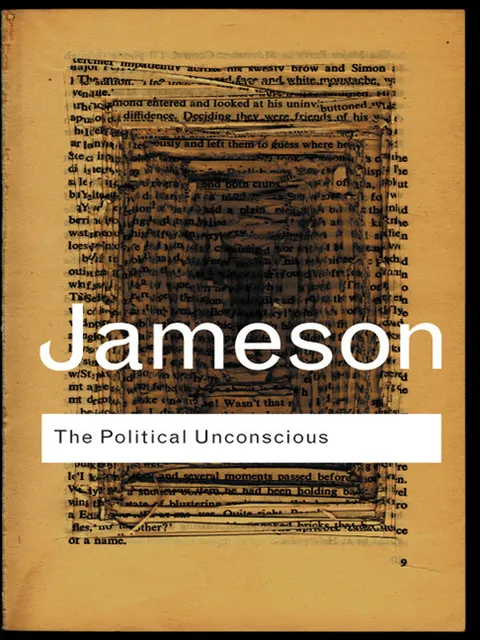
Fredric Jameson, in The Political Unconscious, opposes the view that literary creation can take place in isolation from its political context. He asserts the priority of the political interpretation of literary texts, claiming it to be at the center of all reading and understanding, not just a supplement or auxiliary to other methods current today.
Jameson supports his thesis by looking closely at the nature of interpretation. Our understanding, he says, is colored by the concepts and categories that we inherit from our culture's interpretive tradition and that we use to comprehend what we read. How then can the literature of other ages be understood by readers from a present that is culturally so different from the past? Marxism lies at the foundation of Jameson's answer, because it conceives of history as a single collective narrative that links past and present; Marxist literary criticism reveals the unity of that uninterrupted narrative.
Jameson applies his interpretive theory to nineteenth- and twentieth-century texts, including the works of Balzac, Gissing, and Conrad. Throughout, he considers other interpretive approaches to the works he discusses, assessing the importance and limitations of methods as different as Lacanian psychoanalysis, semiotics, dialectical analysis, and allegorical readings. The book as a whole raises directly issues that have been only implicit in Jameson's earlier work, namely the relationship between dialectics and structuralism, and the tension between the German and the French aesthetic traditions.
The Political Unconscious is a masterly introduction to both the method and the practice of Marxist criticism. Defining a mode of criticism and applying it successfully to individual works, it bridges the gap between theoretical speculation and textual analysis.
Fredric Jameson
Fredric Jameson (14/04/34 - 22/09/24) was Distinguished Professor of Comparative Literature at Duke University. The author of numerous books, he has developed a richly nuanced vision of Western culture's relation to political economy. He was a recipient of the 2008 Holberg International Memorial Prize. He is the author of many books, including Postmodernism, Or, The Cultural Logic of Late Capitalism, The Cultural Turn, A Singular Modernity, Archaeologies of the Future, Brecht and Method, Ideologies of Theory, Valences of the Dialectic, The Hegel Variations and Representing Capital
More by Fredric Jameson


Why Readwise Books?
Readwise Books is an ebook & audiobook platform that automatically logs how much you and your friends read, making it fun and easy to read more. Learn more →