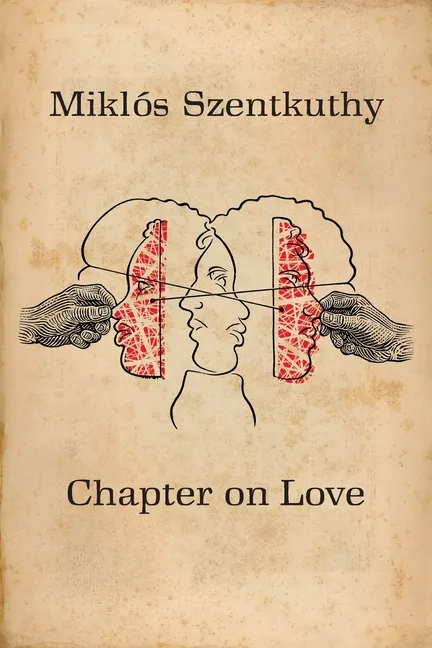
Chapter On Love
Report an issue
Tell us what's wrong and we'll take a look.
Thanks – we got it. We'll review and follow up if needed.
Written between Szentkuthy's first major work, Prae (1934), and the first book of the St. Orpheus Breviary (1939), Chapter on Love (publ. 1936) exemplifies well Szentkuthy's writing of excess. An attempt at polyphonic writing, it brings together the perspectives of an unlikely set of characters including the mayor of a doomed Italian city, given to debilitating "impressionism" - a penchant for observing and analyzing-apart the minutest shades of reality -, a nihilistic pope, a hanged brigand, a courtesan and her decadent pubertal adorer. They pass through the pages of this quixotic and compelling book under the threat of imminent catastrophe, filling chapter after chapter with passionate, self-generating theorizing and (mock-)philosophizing on the margins of Empedocles, life and death, female stockings, endingness and changeability, ethics and aesthetics, vitality and law, chaos and social order grounded in horror vacui, the forever elusive other person - all enmeshed with well-nigh self-parodic, idiosyncratic feats of ratiocination and theorizing driven ad absurdum, which proliferate on the analogy of (free) association.
The common denominator of their analytical furore and the yarns they spin is love, which touches not only on the human being, but the whole of nature, from the realm of plants to that of minerals. Szentkuthy's book may don the costume of a historical novel, but it stands under the sign of the pseudo: its deliberately vague setting, somewhere in Italy toward the end of the Renaissance, is in fact but a mask which allows for anachronism (of realia, ideas, data, and even terminology) to ooze through, as the characters and their observations are our contemporaries in every respect.
Baroque and exuberant, of a sweeping melancholia and at times savage humor, a (mock-)treatise written with an abundance of striking, distant associations that evoke Surrealist practices, this strange novel tantalizingly shows a path not taken by experimental modernism, of the contrapuntal use of point-of-view converted into a contrapuntal use of analytic, essayistic observations of reality, and points towards Szentkuthy's monumental meditations on history sub specie whatsit in the St Orpheus Breviary epic.

Erika Mihálycsa
Translated by
Erika Mihálycsa is Associate Professor at Babeș-Bolyai University, Cluj, where she teaches twentieth- and twenty-first-century British and Irish literature. She has published mainly in the field of Joyce and Beckett studies, on various aspects of literary and visual modernism, and translation studies. With Jolanta Wawrzycka she edited Retranslating Joyce for the 21st Century for the series European Joyce Studies (2020) and is the author of 'A wretchedness to defend' Reading Beckett's letters (2022); her articles have appeared in Word and Image, Joyce Studies Annual, European Joyce Studies, Estudios Irlandeses and numerous edited volumes, among them The Routledge Companion to Literature and Art (2024). She edited Rareș Moldovan's new, annotated Romanian translation of Ulysses (2023) and herself translated works by Beckett, Patrick McCabe, Brian Friel and (with Gábor Csizmadia) Flann O'Brien's At Swim-Two-Birds (2009) into Hungarian.


Why Readwise Books?
Readwise Books is an ebook & audiobook platform that automatically logs how much you and your friends read, making it fun and easy to read more. Learn more →