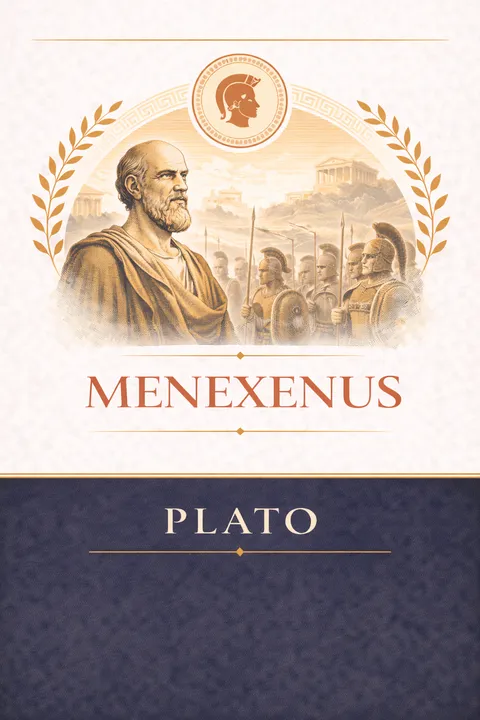
Menexenus
Report an issue
Tell us what's wrong and we'll take a look.
Thanks – we got it. We'll review and follow up if needed.
A speech on honor—or a subtle critique of it? In Menexenus, Plato presents a unique and often overlooked dialogue in which Socrates delivers a funeral oration honoring fallen Athenian soldiers. But beneath the formal praise lies a deeper question: is this speech a genuine tribute—or a satirical reflection on political rhetoric? Blending patriotism with philosophical nuance, Plato invites readers to examine how language shapes public opinion, memory, and national identity. Perfect for readers interested in philosophy, politics, and classical literature, Menexenus offers: A rare example of philosophical rhetoric and oratory Insight into Athenian politics and cultural values A subtle critique of public speech and persuasion A unique and thought-provoking Platonic dialogue Short, layered, and intellectually engaging, Menexenus challenges you to listen closely—not just to what is said, but why. Is every powerful speech truth—or something more persuasive?
Plato
Plato, one of the most renowned ancient Greek philosophers, was born in 427 B.C. to an aristocratic and wealthy family, which played a prominent part in Athenian politics. Plato in conjunction his teacher, Socrates, and his pupil, Aristotle helped to lay the foundations of Western philosophy and culture. While primarily influenced by Socrates, Plato’s work was also affected by the philosophies of Heraclitus, Parmenides, and the Pythagoreans.
Under the guidance of Socrates, Plato devoted himself to the pursuit of wisdom and upon Socrates’ death, joined a group of the Socratic disciples gathered at Megara. Later he travelled in Egypt, Magna Graecia, and Sicily. He returned to Athens and founded a school, known as the Academy, which seems to have been his home base for the remainder of his life.
While thirty-five dialogues and thirteen letters have traditionally been ascribed to Plato, modern scholarship doubts the authenticity of some of them. His early dialogues are also known as the Socratic dialogues and include Apology, Crito, Euthyphro, and Protagoras. He followed these with his transitional dialogues: Gorgias, Meno , and Euthydemus . The Symposium and the Republic are considered the centerpieces of Plato's middle period and are considered some of his most revered work, and other middle dialogues include Phaedo, Phaedrus, and Theaetetus. Plato’s Laws is the best known dialogues of his late period.
Plato died in 347 B.C.
More by Plato





Why Readwise Books?
Readwise Books is an ebook & audiobook platform that automatically logs how much you and your friends read, making it fun and easy to read more. Learn more →