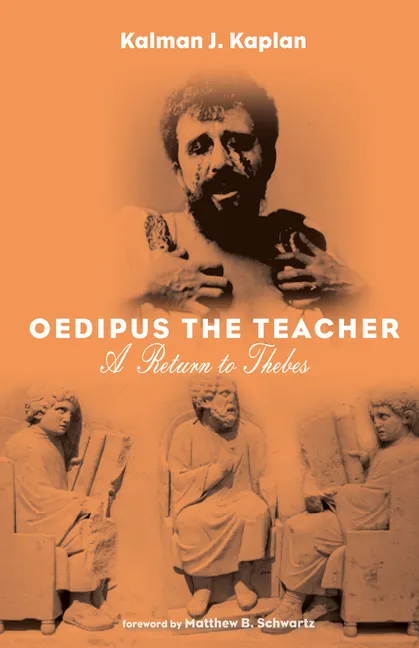
Oedipus The Teacher
Report an issue
Tell us what's wrong and we'll take a look.
Thanks – we got it. We'll review and follow up if needed.
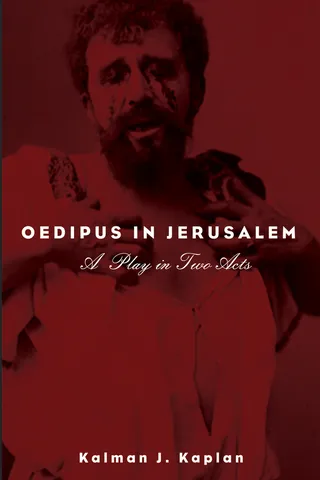
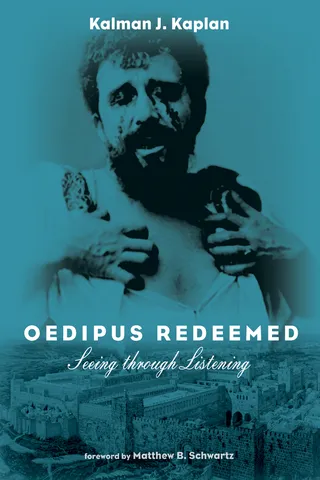
In Oedipus in Jerusalem, the biblical prophet Nathan meets blind Oedipus wandering alone outside of Thebes, becoming convinced that Oedipus has been entrapped by misleading information. He brings him to trial at the Jerusalem Sanhedrin, where Oedipus is acquitted of intentional patricide and incest, but won't accept his acquittal. Oedipus Redeemed describes attempts by Nathan and Sophocles to help Oedipus accept his acquittal, and his self-induced blindness, in the process reuniting him with his daughter Ismene. Oedipus returns to the Sanhedrin, where he agrees to try to emotionally accept the acquittal he has received In this third play, Oedipus the Teacher, Oedipus returns to Thebes with Ismene to teach the lessons he has learned in Jerusalem with the help of a Greek assistant, Kallias, recruited by Sophocles. Oedipus contrasts the destructive results of Greek riddles with parables emergent in biblical narratives. Kallias falls in love with Ismene and becomes rivalrous toward Oedipus, reflecting a distorted Greek view of relations between fathers (older men) and sons (younger men). Several biblical stories are offered as antidotes. Oedipus comes to live with Ismene and Kallias and becomes a doting grandfather. The play ends with the announcement that Oedipus's course is chosen to be taught all over Greece. Oedipus states that he is finally happy.
Kalman J. Kaplan
Kalman J. Kaplan is Professor of Psychiatry at the University of Illinois at Chicago College of Medicine. Dr. Kaplan has published fourteen books and many articles and was awarded a grant from The John Templeton Foundation and Fulbright Foundation awards to develop a program in A Biblical Approach to Mental Health. Among Dr. Kaplan's books are Right to Die versus Sacredness of Life, The Fruit of Her Hands, A Psychology of Hope and Living Biblically.
More by Kalman J. Kaplan


Why Readwise Books?
Readwise Books is an ebook & audiobook platform that automatically logs how much you and your friends read, making it fun and easy to read more. Learn more →