Report an issue
Tell us what's wrong and we'll take a look.
Thanks – we got it. We'll review and follow up if needed.
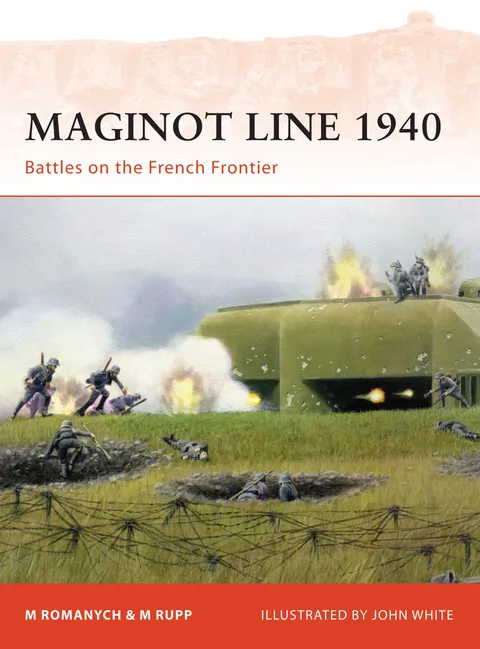
The failure of the Maginot Line shocked the world and lead to the sudden collapse of organized French resistance against Germany.
Constructed throughout the 1930s, the Maginot Line was supposed to form the ultimate defence against a German invasion of France. However, different sections of the line were built at different times and the strength of various sections varied widely. During their Blitzkrieg invasion, the Germans were able to identify these weak points and focus their attacks against them.
This book uses maps and period photographs to tell the story of the five German operations launched against the Maginot Line. While the Germans were able to smash through the lightly defended section of the line along the Meuse River, at other points the line held. Although ultimately the Maginot Line was to prove a failure, the stiff resistance put up by some of the fortresses confirms the fighting ability of the French army during the invasion.
Marc Romanych
Marc Romanych is a retired US Army combat arms officer. He has a Bachelor of Arts degree in History from the University of Maryland and a Master of Arts degree in International Relations from St. Mary's University. He has co-authored several books on World War I and II artillery and fortifications for Osprey Publishing.
More by Marc Romanych


Martin Rupp
Martin Rupp has a Bachelor of Arts degree from the University of Applied Sciences, Saarbrücken. He specializes in fortification and artillery topics and has co-authored books about the battles for the Maginot Line in 1940 and World War I German siege artillery for Osprey Publishing.


Why Readwise Books?
Readwise Books is an ebook & audiobook platform that automatically logs how much you and your friends read, making it fun and easy to read more. Learn more →