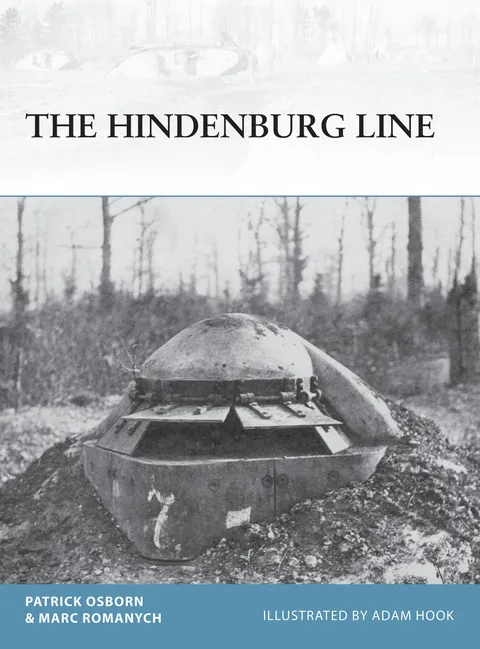
The Hindenburg Line
Report an issue
Tell us what's wrong and we'll take a look.
Thanks – we got it. We'll review and follow up if needed.
Jagging across north-western Europe like a scar, the Hindenburg Line was Germany's most formidable line of defence in World War I.
Its fearsome reputation was matched only by its cunning design, with deep zigzagging trenches, concrete fieldworks, barbed wire and devilish booby traps forming an intimidating barrier for any attacking army.
Through meticulous research, this volume explores each of the major portions of the Hindenburg Line, paying particular attention to three examples of Allied operations against it towards the end of the war: the critical flanking of the Drocourt-Qeant Switch; the daring but costly rupture of the line of the St Quentin Canal; and the bloody battles of the Meuse-Argonne.
Specially commissioned artwork and historical photographs perfectly complement the analysis provided by the authors as they trace the life of the Hindenburg Line from its seemingly invulnerable early years through to the audacious tactics used by the Allies to achieve a bitter victory in 1918.
Patrick Osborn
PATRICK R. OSBORN is a graduate of the University of Missouri-Kansas City and is currently an archivist for the National Archives and Records Administration./e
More by Patrick Osborn
Marc Romanych
Marc Romanych is a retired US Army combat arms officer. He has a Bachelor of Arts degree in History from the University of Maryland and a Master of Arts degree in International Relations from St. Mary's University. He has co-authored several books on World War I and II artillery and fortifications for Osprey Publishing.
More by Marc Romanych



Why Readwise Books?
Readwise Books is an ebook & audiobook platform that automatically logs how much you and your friends read, making it fun and easy to read more. Learn more →