The Idea of Determinism
Report an issue
Tell us what's wrong and we'll take a look.
Thanks – we got it. We'll review and follow up if needed.
The notion of determinism plays heavily in the philosophy of nature. In the classical age of physics (Newton through Maxwell) it was a commonly held assumption that everything can be predicted, and chance is nonexistent. There was also the belief in the perpetual progress toward absolute precision in scientific measurement. Then in 1814 Laplace set the groundwork for this idea in the modern era: "[If there were] an Intelligence who could know, for a given instant, all the forces with which nature is animated and the relative position of all the beings that compose it--if, moreover, it were vast enough to submit all its data to analysis [in accordance with the laws of nature--it] would embrace in the same formula the motions of the greatest bodies in the universe and those of the slightest atom: nothing would be uncertain for it, and the future, like the past, would be present to its eyes."
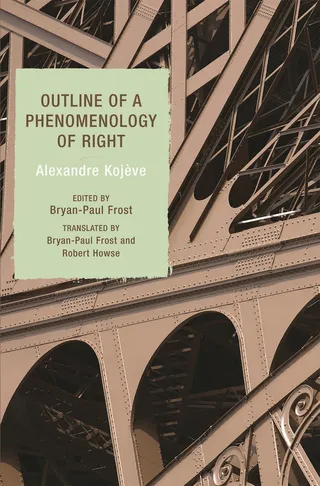
With dialectical mastery, Kojève examines the implications of these assumptions and finds them wanting, even from within the classical perspective. He then turns to the "modern (quantum) physics" of Planck, Heisenberg and Dirac, which he sees as supporting an epistemological understanding of physical science free of any deterministic assumptions. Kojève also finds it to be rooted in the concrete understanding of physical measurement as an interaction between an observing subject and an observed object, about which statistically accurate predictions can legitimately be made.
Kojève was a contemporary and friend to political philosopher Leo Strauss, and influential in the intellectual formation of Allan Bloom and Stanley Rosen. His political career cannot be ignored when attempting to assess the intentions of his philosophical work, which renders it a brand of political philosophy even when making presentations in the field of natural sciences.
Alexandre Kojève
ALEXANDRE KOJ�VE (1902-1968) was one of the major philosophers of the twentieth century. His famous lectures on Hegel and his provocative end-of-history thesis left an indelible mark on contemporary thought. By the end of the Second World War, he abandoned academic philosophy to embark on a diplomatic career. While occupying an influential position in French foreign trade diplomacy, Koj�ve worked on a series of manuscripts which largely remained unpublished until well after his death. Initially dismissed as post-historical irony and play, Koj�ve's post-war philosophical writings should open new perspectives on how we became post-historical and where we go from here.
More by Alexandre Kojève



Why Readwise Books?
Readwise Books is an ebook & audiobook platform that automatically logs how much you and your friends read, making it fun and easy to read more. Learn more →