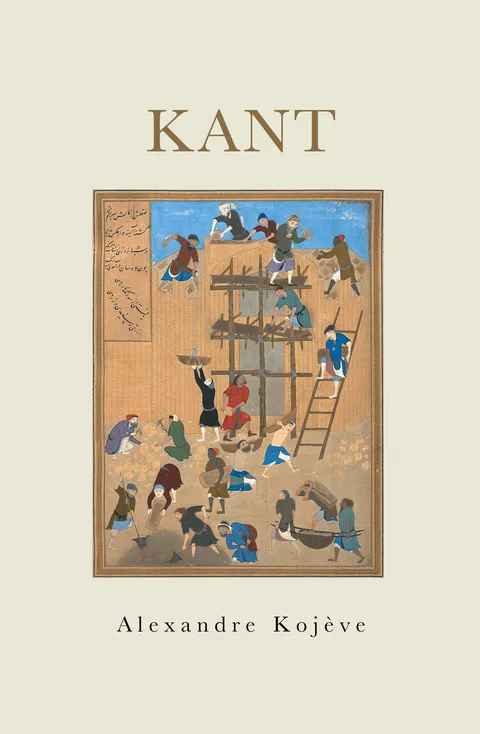
Kant
Report an issue
Tell us what's wrong and we'll take a look.
Thanks – we got it. We'll review and follow up if needed.
Kant forms the centerpiece of Alexandre Kojeve’s intriguing discovery of objective reality and its repressed history in Western philosophy
Immanuel Kant’s philosophical system, Kojève argues, is haunted by the Thing-in-itself as the ultimate expression of ‘bourgeois hypocrisy’ and its internally divided reason, split between action and discourse. Making a case for the post-historical moral imperative to turn away from infinite progress and the practical justification of the ideas of God and the immortality of the soul, Kant outlines the material conditions of possibility for revolutionary action within the twin horizons of accomplished and recollected history.
Alexandre Kojève
ALEXANDRE KOJ�VE (1902-1968) was one of the major philosophers of the twentieth century. His famous lectures on Hegel and his provocative end-of-history thesis left an indelible mark on contemporary thought. By the end of the Second World War, he abandoned academic philosophy to embark on a diplomatic career. While occupying an influential position in French foreign trade diplomacy, Koj�ve worked on a series of manuscripts which largely remained unpublished until well after his death. Initially dismissed as post-historical irony and play, Koj�ve's post-war philosophical writings should open new perspectives on how we became post-historical and where we go from here.
More by Alexandre Kojève

Hager Weslati
Translated by
Hager Weslati is a lecturer in Media and Cultural Studies at the Kingston University of London. Her recent writings include "Travel in Disguise: On Travel Writing and Cultural Governance" in Not So Innocent Abroad: the Politics of Travel and Travel Writing and "Deserts in Literary and Religious Fundamentalism" in Literary Encounters of Fundamentalism.


Why Readwise Books?
Readwise Books is an ebook & audiobook platform that automatically logs how much you and your friends read, making it fun and easy to read more. Learn more →