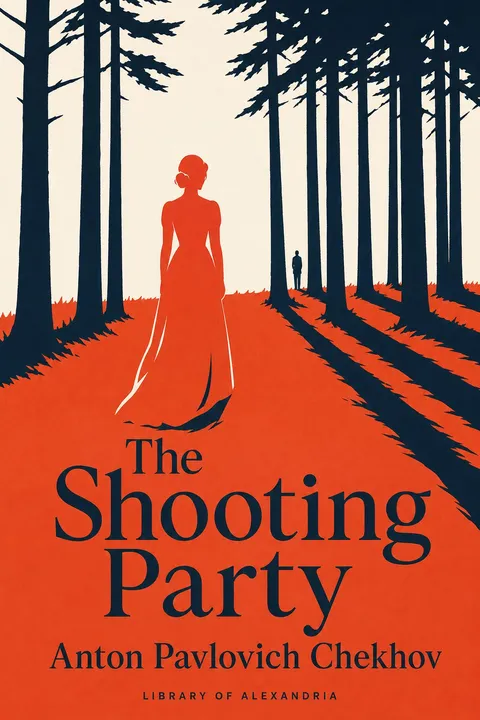
The Shooting Party
Russian Crime Fiction of Desire, Murder, and a Narrator You Cannot Trust
Report an issue
Tell us what's wrong and we'll take a look.
Thanks – we got it. We'll review and follow up if needed.
A woman is murdered, a suspect is within reach, and the man telling the story seems to know far too much. Can a compelling account also be a way of hiding the truth?
In Anton Chekhov's The Shooting Party, a former magistrate named Kamyshev brings a newspaper editor a manuscript drawn from his own experience. Its subject is love and murder in provincial Russia. At its center stands Olga, the beautiful daughter of a forester, whose presence unsettles the men around her: a dissolute count, the aging estate bailiff Urbenin, and Kamyshev himself. When she is found dying in the forest after a hunting gathering, desire gives way to suspicion and an investigation begins.
Yet the crime is only part of the mystery. The editor's framing narrative places Kamyshev's account under scrutiny, turning his confidence, omissions, and explanations into evidence of another kind. Written early in Chekhov's career, the novel combines the attractions of a murder mystery with a corrosive portrait of privilege and provincial justice. Its enduring challenge is as immediate as ever: how do we judge a story when its teller has every reason to shape what we believe?
What readers find inside:
- An unreliable narrator - Kamyshev's account makes the distance between persuasive storytelling and truth the heart of the mystery.
- Desire and jealousy - Olga's relationships expose possessiveness, wounded pride, and the unequal power of men and women.
- A Russian country estate - Aristocratic indulgence and rural dependence form the social world surrounding the crime.
- Justice under suspicion - The investigation reveals how authority and convenient assumptions can distort the search for evidence.
- A story within a story - The editor's response to the manuscript asks readers to reconsider the narrative they have been given.
For readers of classic Russian literature, psychological mysteries, and crime fiction that rewards close attention, this is a dark encounter with the dangers of taking a narrator at his word.
Enter the estate and follow the clues in both the crime and its telling.
Anton Chekhov
Piero Brunello is a professor at the University of Venice. Lena Lencek is a professor at Reed College in Portland, Oregon.
More by Anton Chekhov




Why Readwise Books?
Readwise Books is an ebook & audiobook platform that automatically logs how much you and your friends read, making it fun and easy to read more. Learn more →